I don’t often knit a sweater exactly as the pattern says. Don’t get me wrong, I’m not some kind of knitting goddess who can make a sweater up as she goes and still have it sized to fit me. It’s just that a pattern will say Japanese short rows, and I go “no thanks, I’ll stick with my German short rows” or it’ll say long sleeves and I don’t want long sleeves. Nothing major, I just change things to fit my knitting and wearing preferences.
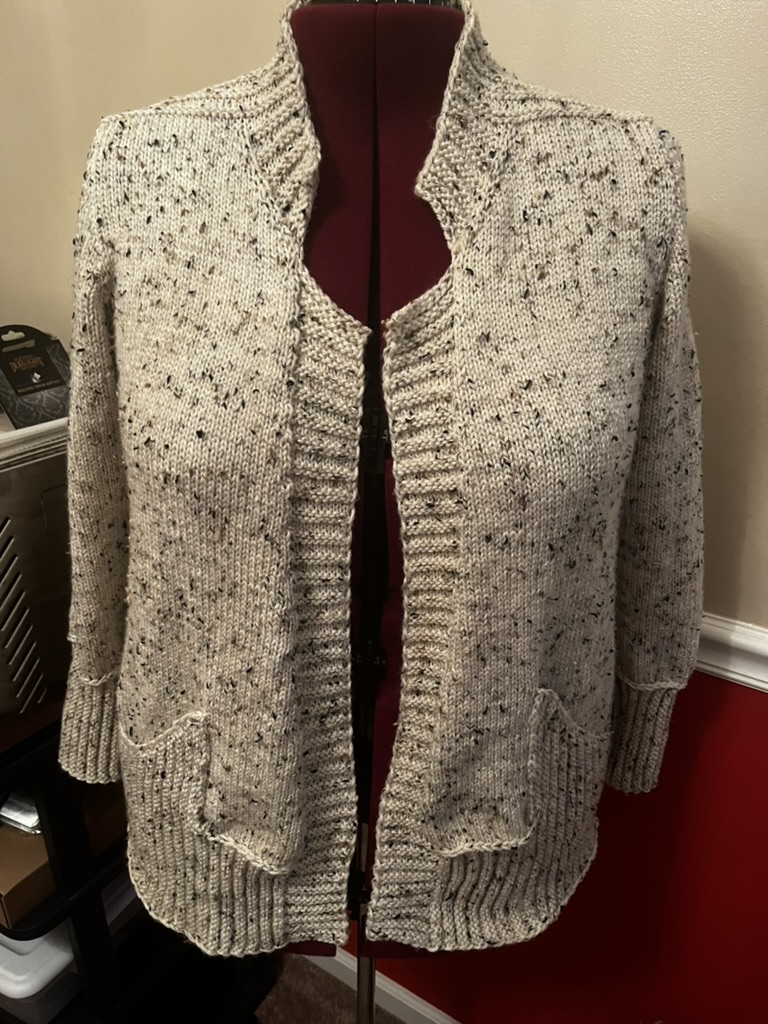
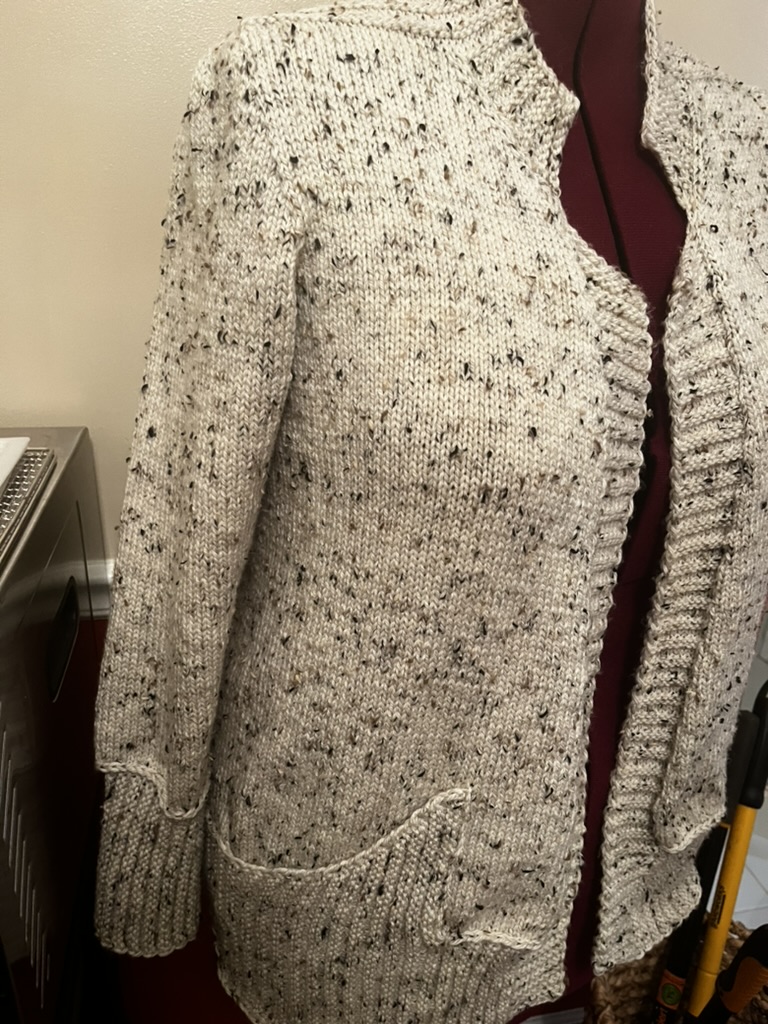
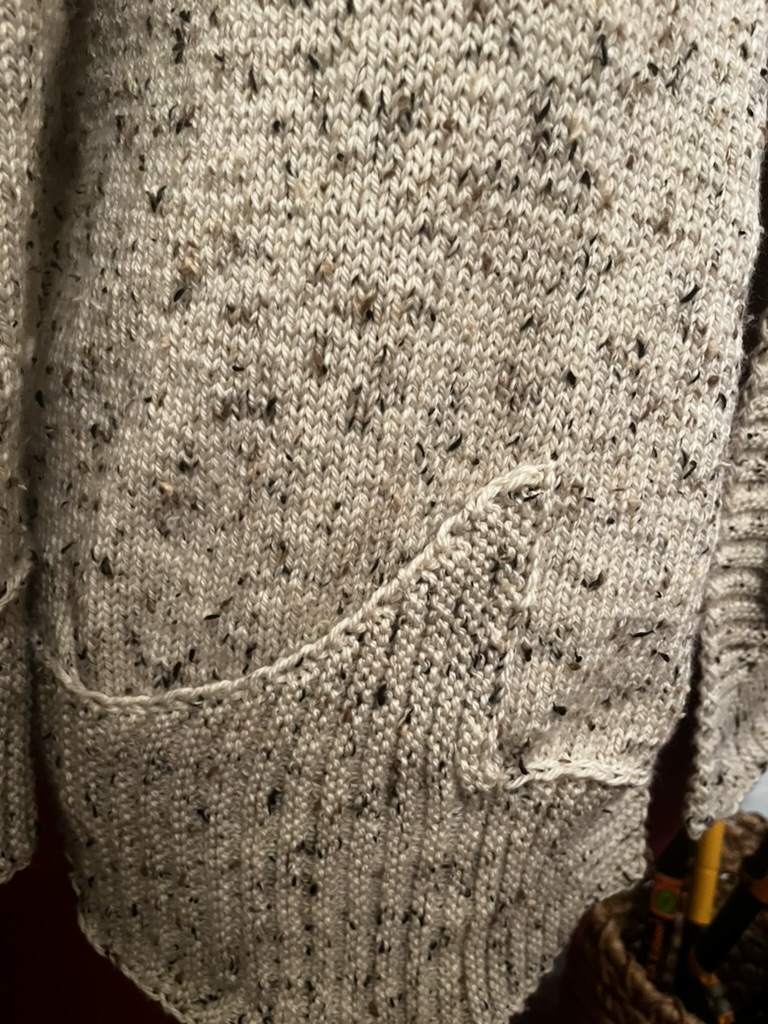
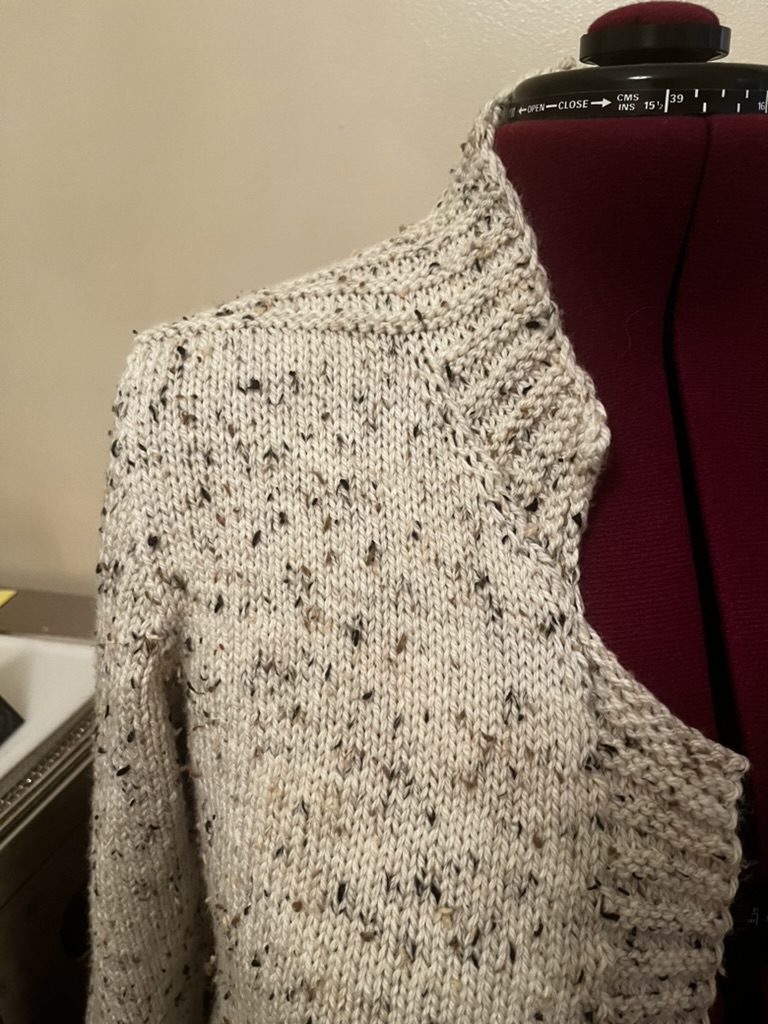
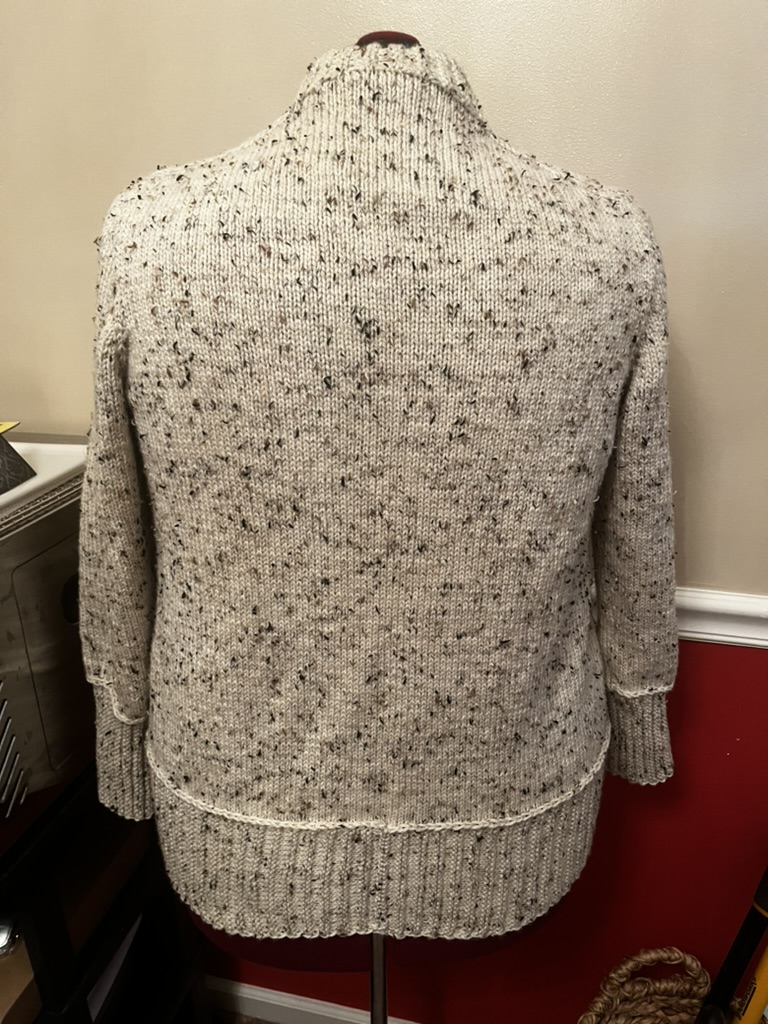
This, though, is the Big Sister cardigan by Hinterm Stein, and for the first time in ages, I didn’t find a single thing in the pattern I wanted to change. The start, a rectangle on the back, increasing into the shoulders and then fronts, is cleverly done and intuitive. The notch at the collar is just right, and keeps the faux-ribbing at the edges from pulling in too much and looking like the button band area is a size too small. Knitting on the bottom edging with the 1-2 decrease pattern works perfectly. Also, done in aran yarn (which is undyed donegal aran from wool2dyefor), it’s going to be a super snuggly sweater for the wintertime, which given the local climate, will be able to double as my winter coat. Given the deep pockets, I think it’ll be the perfect winter coat.
Hey! It’s not blocked yet, but my crisscross shirt is done. The edges are rolling a little in the photos, but I’m sure a wash and block will cure that. As is my usual issue with speckled yarn, I think it looks better in person than photos, so I’m sorry they look pretty meh. (the yarn in the skein looks beautiful, obviously, and in person, the sweater looks pretty great in my opinion.)
The pattern is nice and simple, well-written and easy to follow, with a great schematic, and I’ll definitely be keeping an eye on the designer in the future. Love these useful, wearable designs, and think I’ll get a lot of use out of the sweater.
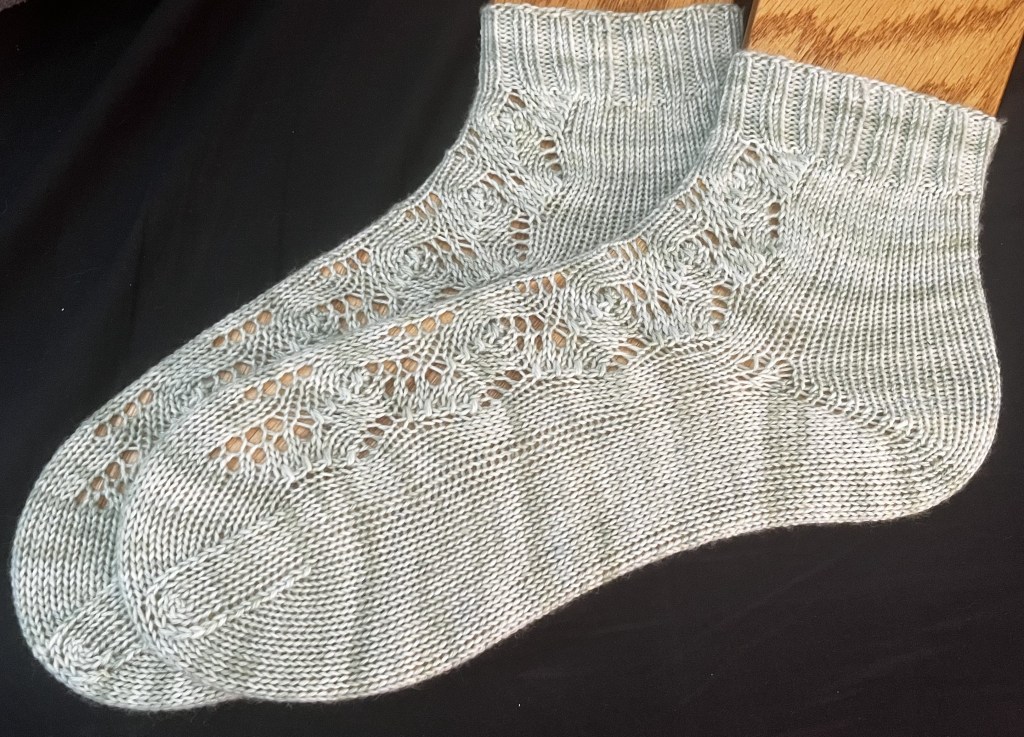
Back to those #PridePodMAL socks, they’re done! This is what happens when you make socks for a person with tiny feet, I think, and it’s kind of amazing. They took maybe 12 hours of knitting all together, and they’re done. Again, it’s the Wildwood Socks pattern by Catherine Meyer aka GingerDogKnits. The lace pattern is quite simple, both written and charted, and I love how it turns out.
The color is terribly washed out in the photo, it’s called pistachio, and IRL it’s a beautiful tonal cool green I got from the Etsy shop WhimzeeStitches. I’m really glad I probably have enough left of it to make myself a pair of short socks too.
Since the socks are very small, I didn’t block them on my giant foot sock blockers and stretch them all out of shape; I’m waiting till a pair of smaller blockers I ordered comes in, since I won’t be seeing the recipient for the next few weeks anyway. I know sock blockers aren’t a requirement, but I like the uniform way they make the socks look, so I use them.
This is the first time I’ve finished a pair of socks in . . . a while. But they went well and were fun, so I think I’ll be going back to more of them. Goodness knows I have enough sock yarn waiting to be used.
Since I don’t have enough to do in June, or maybe ever, I’ve also decided to take part in Camp Loopy, hosted by The Loopy Ewe every summer. I used to do them early on, and when they emailed this May, I was in the mood for some lovely timed knitting.
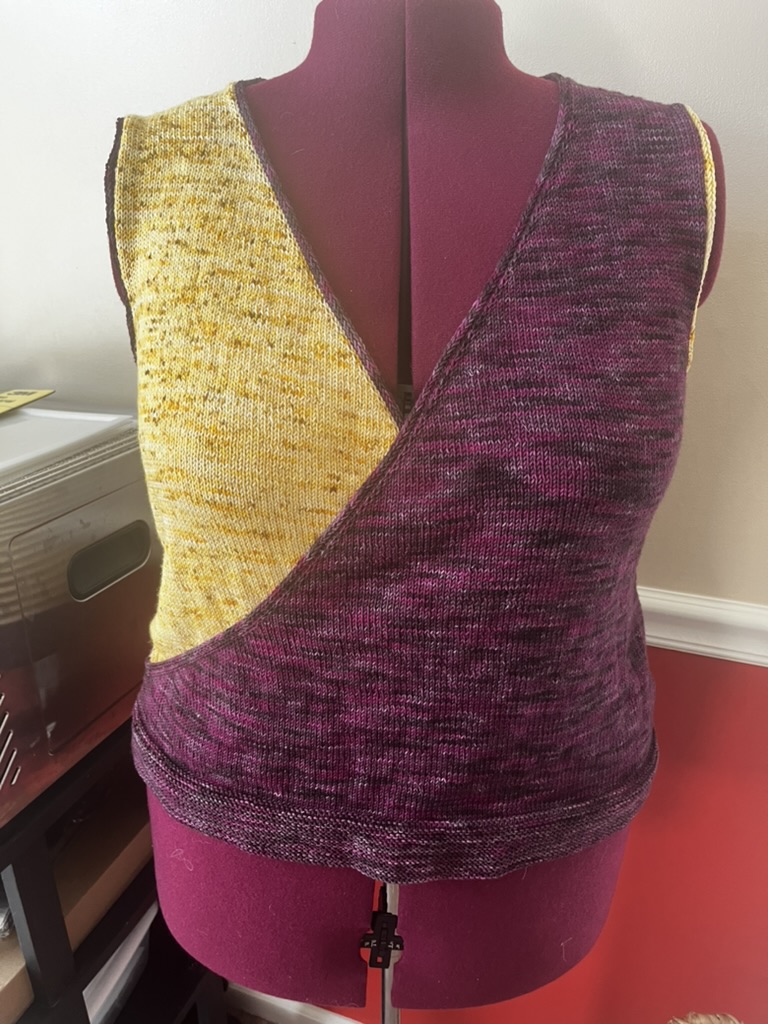
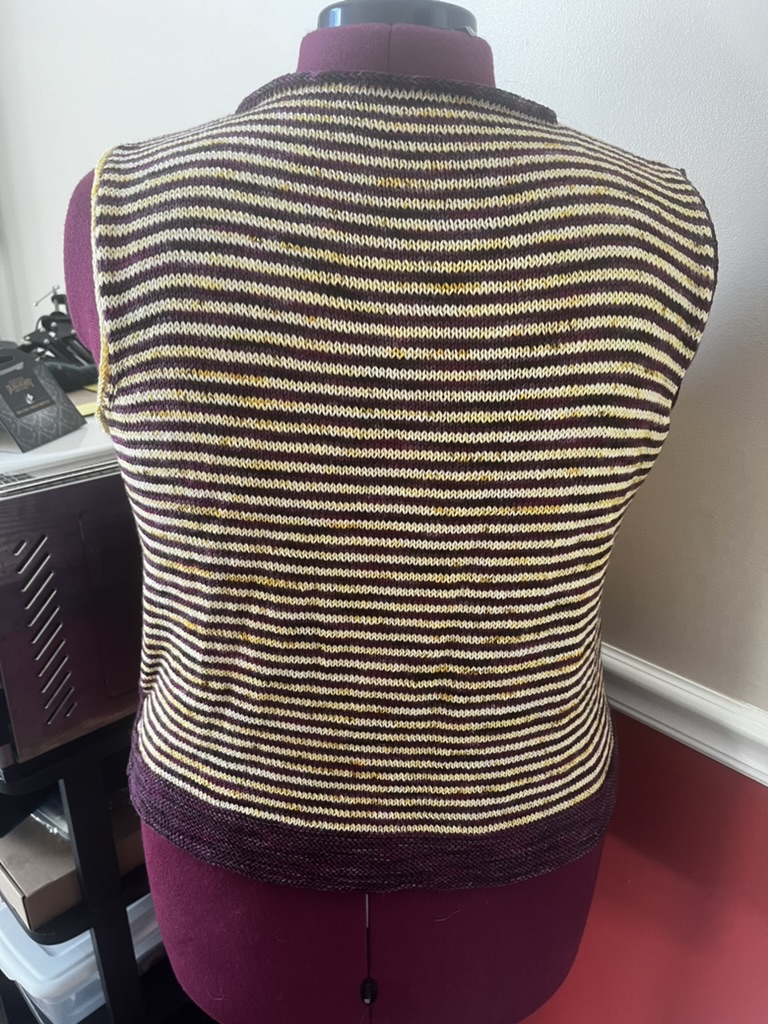
The first month’s mission is pretty simple: I’m looking for a double agent. (yes, it’s silly, just go with it.) So I got myself two different colors of Wollmeise Twin to make the Applesauce shirt by Noriko Ho, doubling up all over the place.
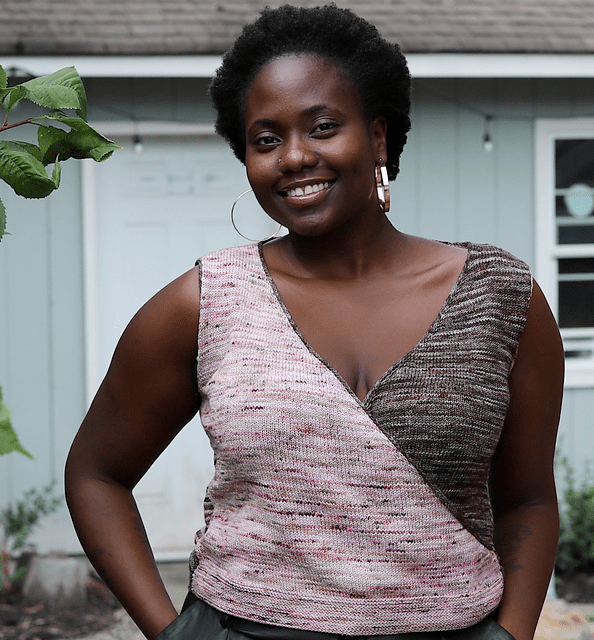
Here’s the pattern sample of the sweater, sleeveless as I intend to make it.
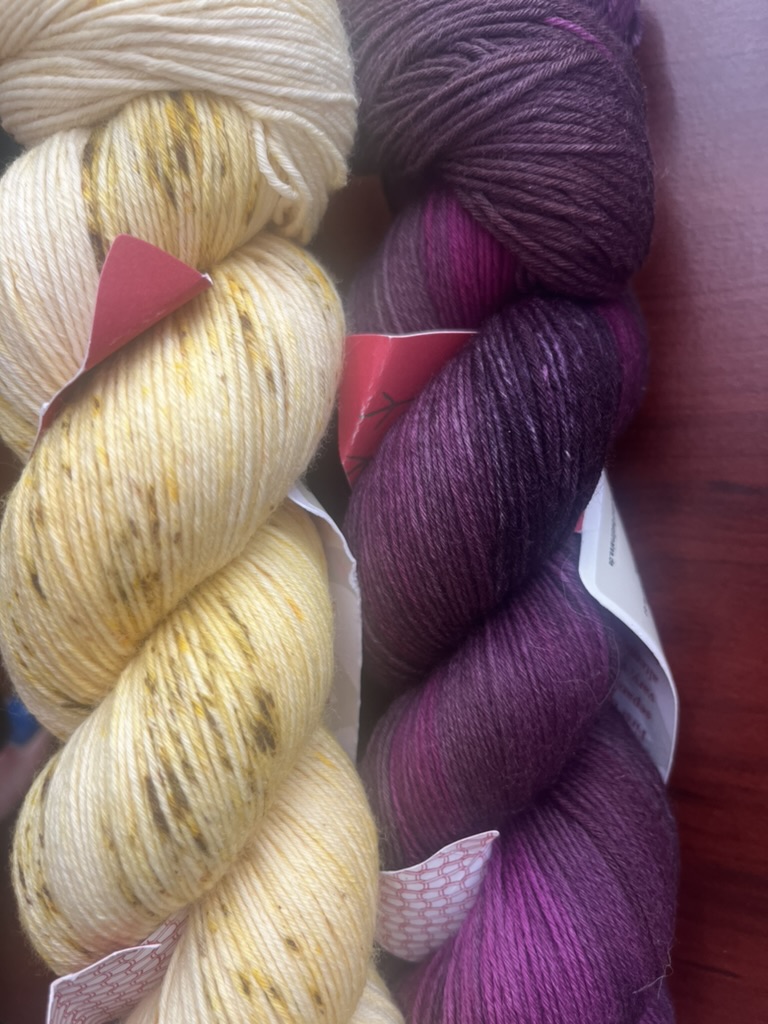
I’m going to make it from a beautiful speckled yellow and even more beautiful variegated purple / burgundy:
Shouldn’t be more than a few days of knitting, and I’m looking forward to getting it done!
One of the podcasts I’ve been listening to started talking about a Pride make-along a few months back, and she said that other podcasts were also involved. So the result has been that I started listening to / watching another few podcasts that are also involved, bought some yarn and project bags, and will be getting a pattern to get involved.
Because at this point in life, I’m all about Pride. The very concept is the opposite of shame, which we’ve been trained to feel for too many reasons, and I no longer have any use for that in my life.
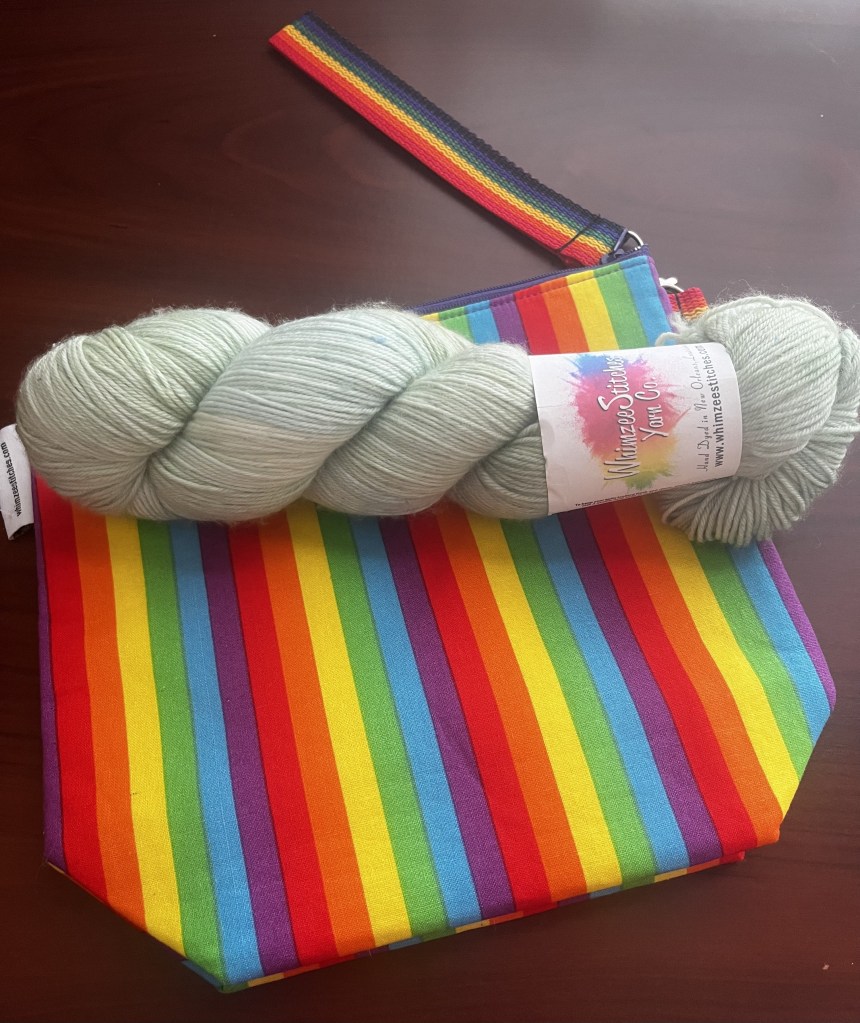
Not that a rainbow bag and ace flag wallet is going to change the world, but also . . . in small ways, we can all change the world. One person and one interaction at a time.
So today I’m casting on some Wildwood Socks by Catherine Meyer with Whimzee Stitches yarn, in one of their project bags as well. So LGBTQA+ creators all around, including the knitter, since I’m maybe the acest romance writer out there. Not that it’s a competition.
If you want to join me, they’ve got a group over here: Pride Pod MAL
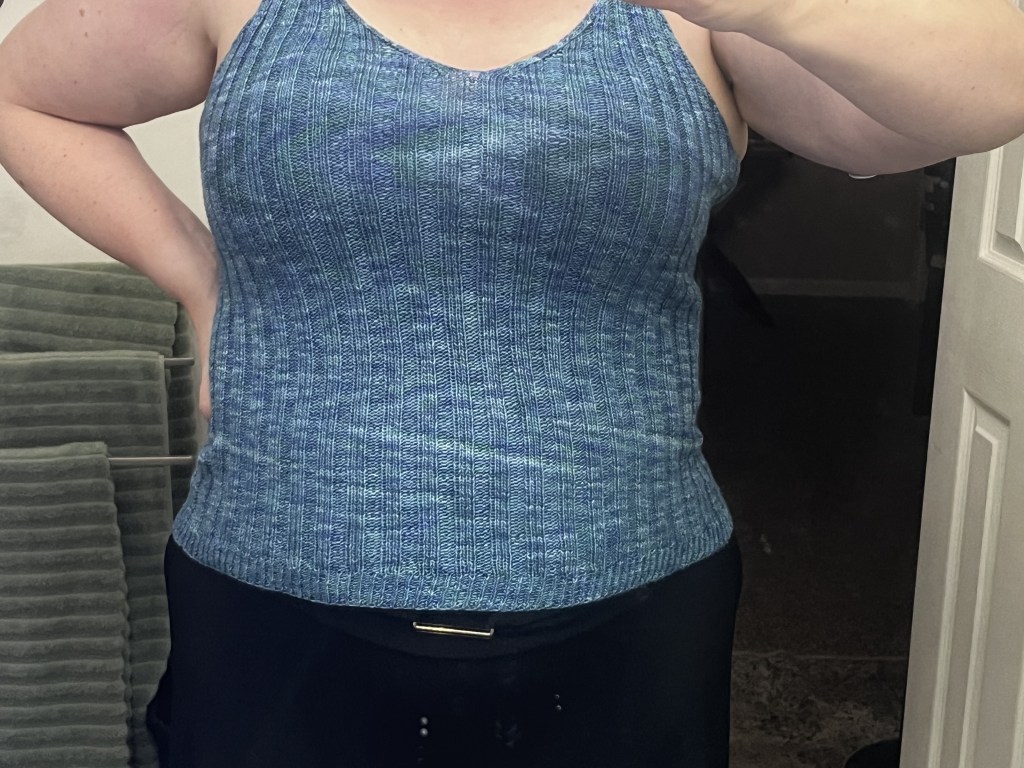
About four years ago I made a Ripple Bralette by Jessie Maed Designs, who might just be my favorite designer. Okay, one of them. One can never discount Joji Locatelli, and I like them for similar reasons: they design relatively simple sweaters with clever construction, that are thoroughly wearable garments. None of that stuff your great grandmother made with extra bobbles and chevrons and 576 colors.
The initial bralette was a single skein of green yarn, and it made a nice layering piece for the dead of frozen winter in Iowa, but it also got me thinking: wouldn’t this make a great tank top, if I just made it long?
So I grabbed two hanks of Ella Rae lace merino (which is, ironically, actually a light fingering weight yarn) both in the same lovely blue-green colorway—the brand unfortunately doesn’t give them fun names, but numbers, and I don’t remember this boring number. I wound them both and stuck them in a project bag in my car. At the time, because of an issue with the car, I was spending a lot of time sitting in the car doing nothing, so I figured I could instead spend that time working 3×3 ribbing on tiny needles forever.
The problem was that when we moved to North Carolina, I wasn’t doing that anymore, so what had been a project moving slowly but steadily forward became entirely stagnant. When I took it out of my car and brought it in to work on last week, I thought I’d continue to take forever to finish it, but it turns out I didn’t have that much left. I finished it, one of the few patterns I knit precisely to pattern, no major changes to what the designer wrote, other than knitting the body for about 14″ instead of 4″.
Since I started it years ago, that also meant it was made two or three sizes larger than necessary, but in the end, I think that doesn’t show at all, since it’s knit in ribbing, and is still 100% fitted.
I’ll definitely, always, be making more of Jessie’s patterns. Fabulous construction and easy to wear, love it.
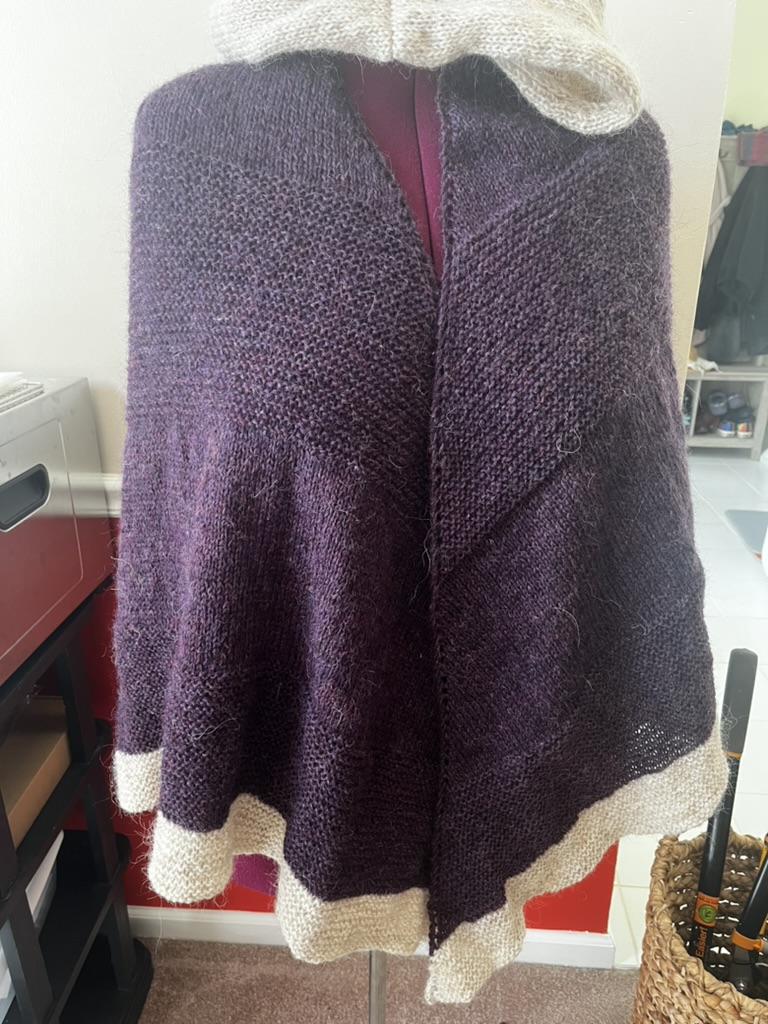
Yeah, so anyone who got here from my writing knows darn well I fantasize about being the actual fox whisperer. I guess making the hooded shawl pattern by the same name will have to do, though.
Here’s The Fox Whisperer, by Judy Jewell. She’s a new to me designer, and I found her because . . . why yes, I did just type “fox” into Ravelry‘s pattern search just to see what came up. Honestly, their database just tickles the techie in me. SO MANY search parameters. Sure, you can search for random fox patterns, but you can also search by yarn, yarn weight, yardage/meterage, pattern type, desired gauge, and dozens of other things. I only got about a year into a programming degree as a wee 20-something, but Cassidy of Ravelry is 20-something me’s programming hero. Whenever someone asks what a database is good for, Ravelry is the answer.
Anyway, The Fox Whisperer. The sample is knit in a lopi unspun yarn, and it’s the recommended yarn as well. All my years knitting, this is actually the first time I’ve worked with a lopi yarn. I got mine at The Icelandic Store, frankly because I’m a little cheap, and even with insanely expensive international shipping, it’s cheaper than you can get it from anywhere here in the US.
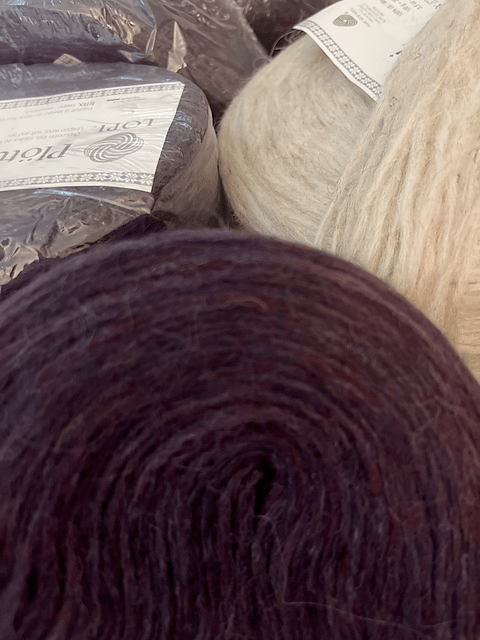
My yarn, in my chosen colors. The purple really doesn’t photograph well, but it’s a beautiful plum shade.
Now, the designer used a lighter yarn held double, but since I went with ístex’s Plötulopi, I only held a single strand the whole time.
About the yarn: It comes in what the designer calls plates, and I think that’s a fair description. They’re flat-ish and round, basically discs of yarn. They’re also just what the name says: unspun. This isn’t a singles yarn, or twisted tight like those lovely bouncy plied yarns most of us are used to. It’s just wool fibers held loosely together by the friction created by wool’s scaly nature. If you tug on the end of this yarn, it’ll come apart in your hands. This effect is so strong that there’s a note on the maker’s website that suggests knitting continental style to avoid extra tugging that can make the yarn come apart.
So I’ll just come out and say it. This is not my favorite yarn to work with. I knit semi-English (most people I’ve seen talk about it call the style I use “flicking”), and while I don’t tension tight enough that I had a problem with it coming apart much while I was working, a few times when I set the project down and came back to it, just the act of picking up the shawl made the yarn break. There’s a note in the pattern that says when wet, the shawl is incredibly delicate, and will fall apart, so to be very careful with it. This is not hard to imagine being true. While it’s pretty hardy all knit up together, wet wool is more delicate than dry, and this unspun stuff is like air.
I’m not saying I dislike it, or not to knit with it—it definitely has its place, and I think it’ll make incredible colorwork. In fact, I’ve got my eye on, and the yarn for, Into the Wild by Tania Barley. Mostly, I’m just saying it’s never going to be my very favorite yarn. For anyone sensitive to this issue, it’s also definitely a rustic wool, and people who don’t like the idea of wool probably couldn’t wear it next to their skin. FWIW, I used to be one of those people, and once I fell in love with wool, my tolerance for “itchiness” increased quite a lot. If that’s you, maybe start with a nice cushy superwash merino and work your way up from there.
The pattern was great, and written in a lovely conversational style, so I’ll definitely be considering future patterns by the designer. I left off the picot edging because I don’t much like picots, and didn’t decrease the hood because I prefer a deep hood, but those were simple changes, nothing that changed the essential pattern, which was quite simple.
Sorry for the lack of a good hood picture, but I can’t take that myself, and Mr. Lucky isn’t much of a photographer.
It’ll be hard to believe for anyone looking at the projects side by side, but this project used about the same amount of yardage as the Minerva Cardigan. How? This was knit on a size 9 US needle, and Minerva was a size 5, with much thinner yarn. I haven’t worked up the courage to block it yet because of the dire threats that it’ll fall apart, but I’ll get there. Probably.
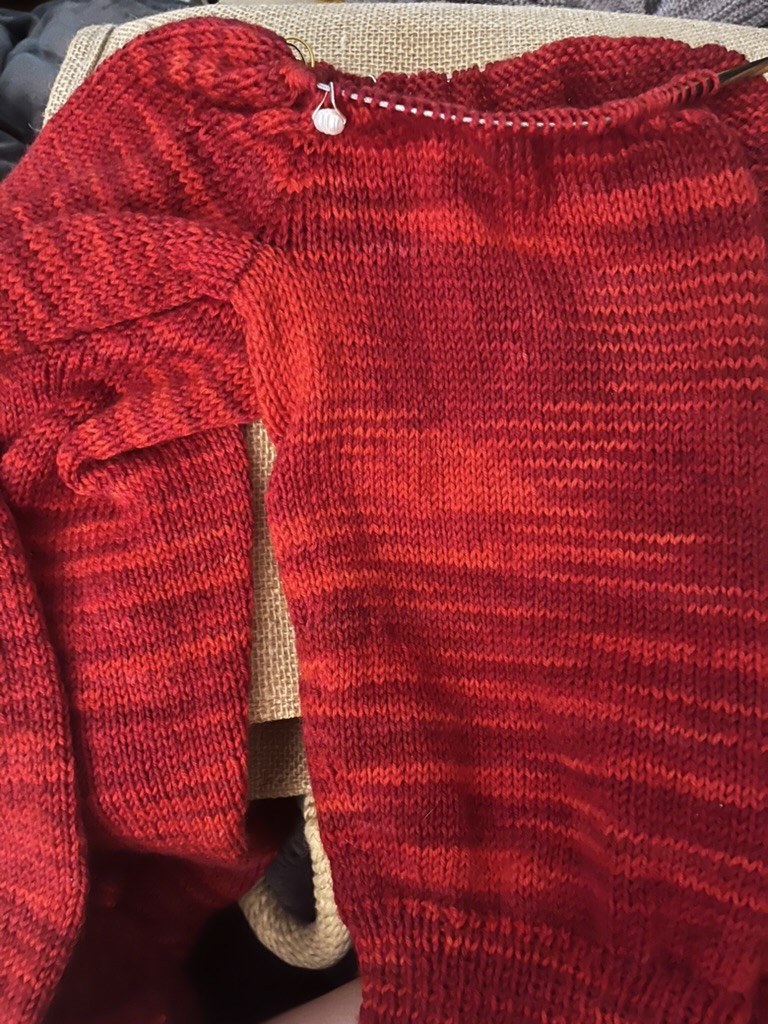
And so far, the cardigan had taken me four days: two for the main body, and two for these little sleeve nubbins. The remainder of the sleeves took me another day and a half of steady knitting, and then I connected them to the body.
If you haven’t knit a bottom-up sweater, be forewarned, the five or ten rows after you connect sleeves to a body are a pain in the butt. You have to keep the sleeves very bunched up and all on the needles at once, because you’re essentially asking what was flat to become round. Technically, the sleeves being knit in the round, this isn’t actually what you’re doing, but the spots where body meets sleeve are very stubborn and don’t like their new place in life, so they take it out on you for a while.
Here we are, some measure into the rest. With three balls wound, I used one to do the body, and one for each sleeve. Then when I connected the body, I went back to the one I’d been using there. It ran out right about the time of this picture, so I attached one of the sleeve balls and continued on. That second ball was enough to finish the sweater, so I used a total of 2.5 balls, meaning the whole sweater cost under $50, including enough extra yarn to make a pair of short socks or a hat or something.
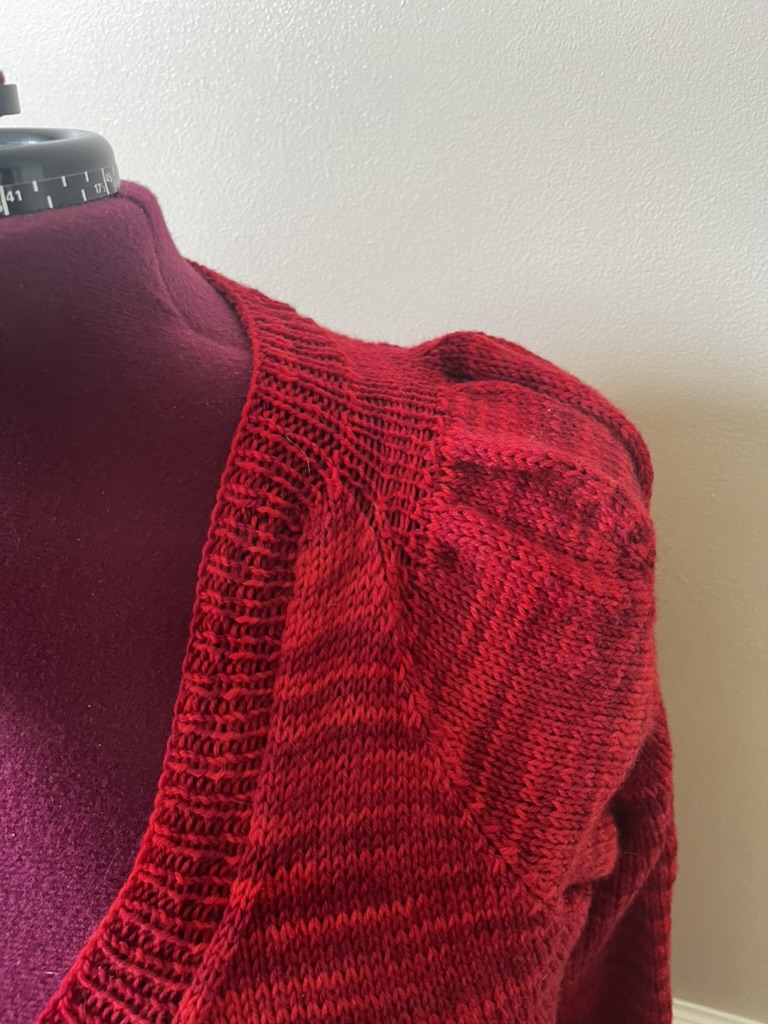
I’ll note here that the sweater was written by someone whose first language isn’t English, so there was one point in the pattern I was concerned people might be confused by: Once she says to start the raglan increases, you continue them for the rest of the sweater until you get to the neck. When she goes to the explanation of how to increase for the sleeve puffs, you continue the raglan decreases as you have been every other row, even though the pattern is a little vague about that part.
The sleeve puffs? Are fabulous. Honestly, they make me want to knit another one, because I just love the construction of them, I’ll definitely be knitting more patterns by the designer, because this one is lovely and elegant in its finished version.
Oh, you actually wanted to see the whole sweater?
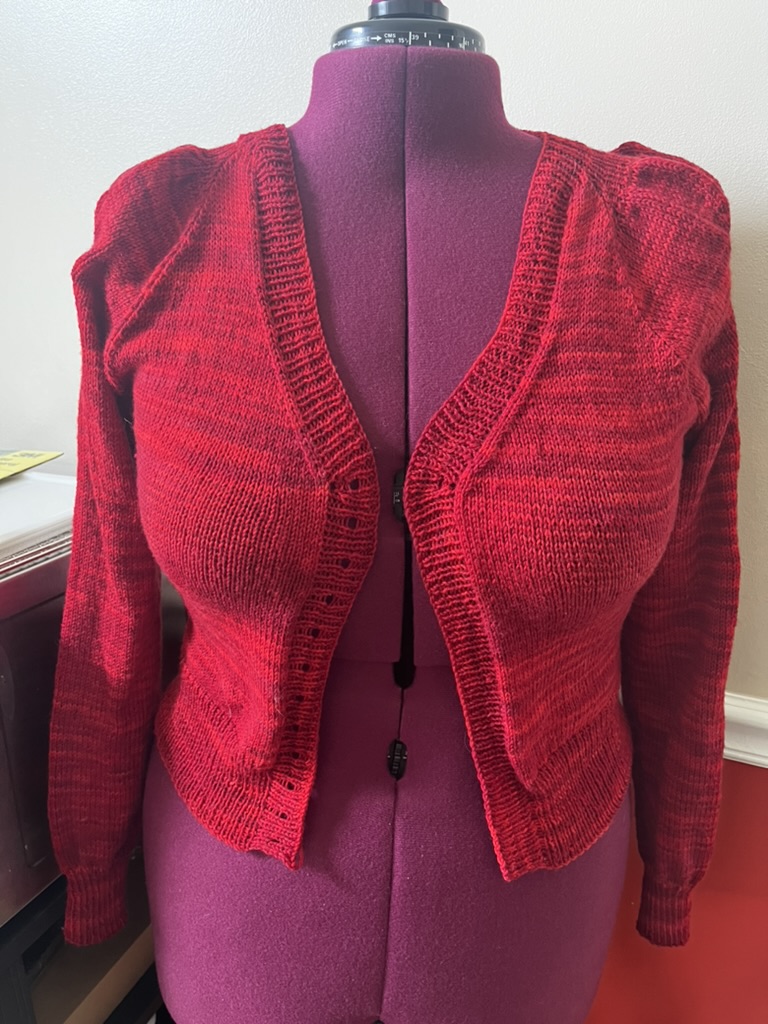
I guess. Well, fair warning, I haven’t sewn the buttons on yet, because like every knitter, finishing eludes me sometimes. I did the knitting, why is there more work? But yeah, here’s Minerva:
It’s a little tight, but that’s probably back to my slightly-small gauge rather than the pattern. It’s also not too tight, I’m mostly worried about the buttons pulling a little when I finish and put it on. Maybe in another five pounds or so.
All together, Minerva took me about six or seven days of knitting, and a lot of them were just the sleeves. Those sleeves’ll get you every time. But don’t get trapped on sleeve island. The sweater’s worth finishing. It totaled about 1200 yards of yarn for my size 2x behind, so it’s a tiny amount of yarn, for a full sleeve sweater.
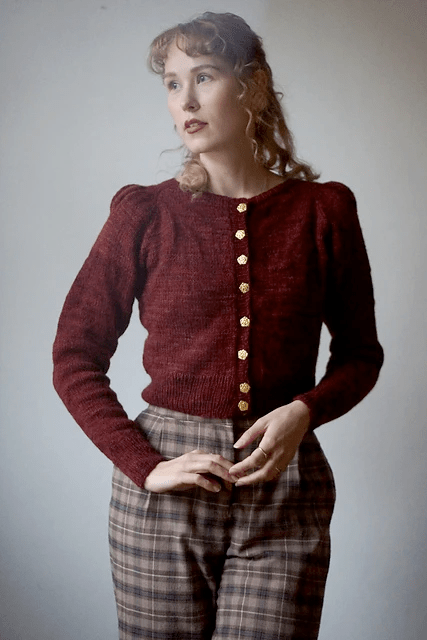
So last week, I finished a sweater. This week, I’m going to talk about it. Here’s the pattern’s sample picture, for reference:
It’s the Minerva Cardigan, by Fabel Knitwear, and while it was initially inspired by the well known series about a boy wizard, the pattern writer has also said they stand with the trans community against the author’s sadly well-known vitriol against trans people. I appreciated the statement, so decided to go with the sweater in spite of the name.
First course of action, then, was to choose the yarn. Something about the look of the sweater screams red to me, so while I didn’t have a rich burgundy like the sample in the pattern pictures, I did have a tonal cherry red, which seemed perfect to me. It was even a Knit Picks yarn, one of their Stroll tonal line, in a color called Heartfelt. It’s even still available for $14.99 a hank, if you want to make a sweater with it, and it’s kind of a steal, like most KP yarn. In case you’re not aware of them, Knit Picks is generally a good step between big box store acrylics and super expensive wools, so if you’re in that stage where you want to try something better than Red Heart but you’re not sure about spending that much money, they’re a pretty good bet.
Warning: This yarn comes in hanks. It’s not prewound into balls. This means to use it, you’ll either need help from a friend with tools or local yarn store, or you’ll need to own tools for winding yarn. This can be as simple as a chair and a nostepinne, if you’re willing to spend hours winding yarn, or as complex and expensive as a swift and ball winder, if you want it done fast and are willing and able to spend more. Having been doing this for many years, and in large amounts, I have the tools in question, and can talk further about them if anyone wants to hear it.
I had four hanks, so that was certainly enough to make any size I needed. Measurements said I should have made the XL, which would have been the first time I made an XL instead of a 2X in many years, but ironically, my gauge swatch said I was a little off, so I sized up to make sure it would fit.
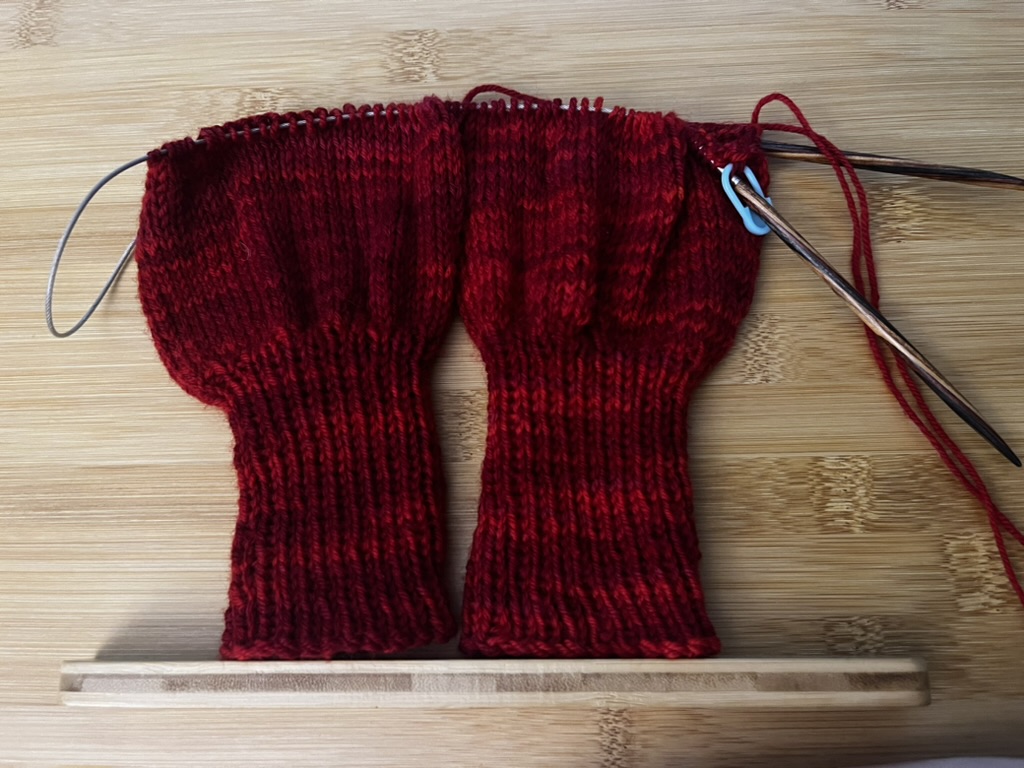
Finally, with three of my four hanks wound into balls, I was ready to get started. The pattern starts with the body, which took the better part of one hank, and then when you’re ready to attach the sleeves, well . . . you have to make the sleeves. Which I must say, for this sweater, was painful. They’re full length sleeves, which I rarely knit since I run hot, and they seemed to go on forever. This is a thing knitters call “sleeve island,” which I think has something to do with the feeling of being trapped and unable to escape that knitting sleeves gives one. Fortunately, I suspected I was going to end up there, so I knit them both at the same time, magic loop, so I wouldn’t have to do one, then the other, which might have led to a single finished sleeve and abandoned project.
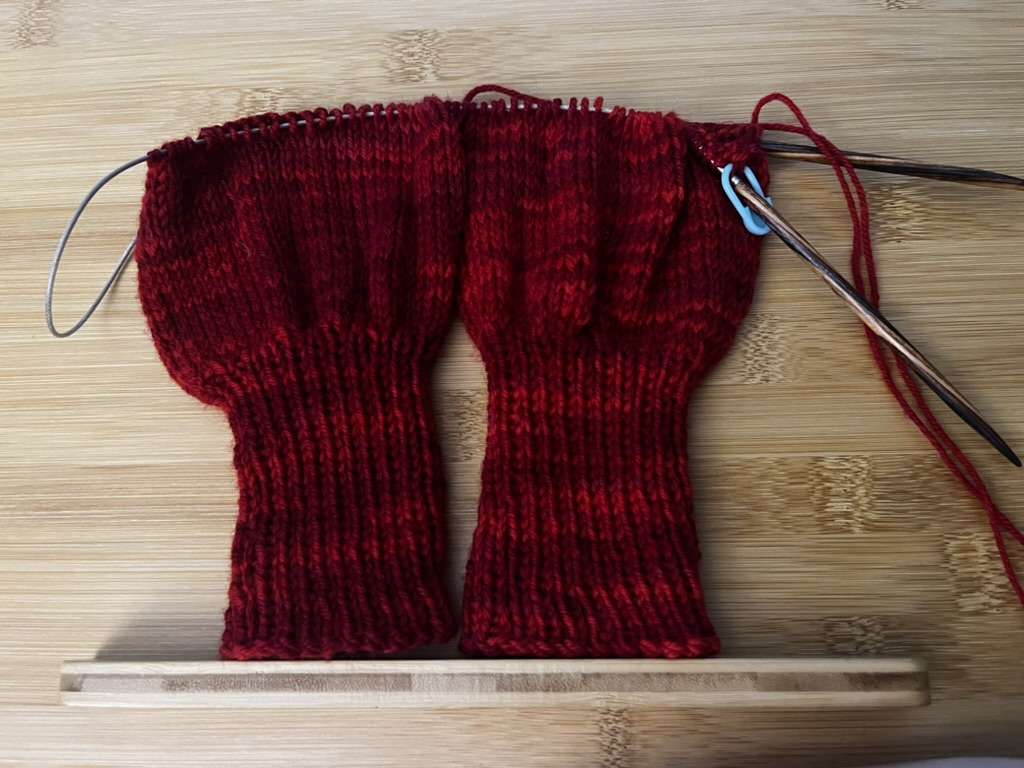
Sleeves at about 5″, after the first two days of work on them.
Since this is already running ridiculously long, I’ll come back Friday with more on Minerva. Till then, happy knitting!
This is the world’s easiest “lace” pattern. It’s just yo/k2tog across on one side, purl back on the other. Yeah, it’s got a tiny border of garter stitch to neaten up the edge, but generally speaking, this is a thing anyone can do with no pattern, and I’m doing it, a few rows at a time, long term. It’s sitting in my office next to my computer, as something to do with my hands when I need to stop writing for a moment and think, because I think best when I have something like this to do at the same time. the simplicity of the thing helps because it doesn’t require any thought, so it’s just a physical distraction, not a mental one. At this rate, though, it’s going to take all summer to finish. Maybe longer.
The color of the yarn is, despite it being both the colors I’ve most often had my hair in the last 40 years, not something I’d ever wear, so I suspect I’ll give it away to someone on patreon after it’s finished. Still, it’s going to help me write some books while it’s in process!

 Knitting Over the Rainbow