I don’t often knit a sweater exactly as the pattern says. Don’t get me wrong, I’m not some kind of knitting goddess who can make a sweater up as she goes and still have it sized to fit me. It’s just that a pattern will say Japanese short rows, and I go “no thanks, I’ll stick with my German short rows” or it’ll say long sleeves and I don’t want long sleeves. Nothing major, I just change things to fit my knitting and wearing preferences.
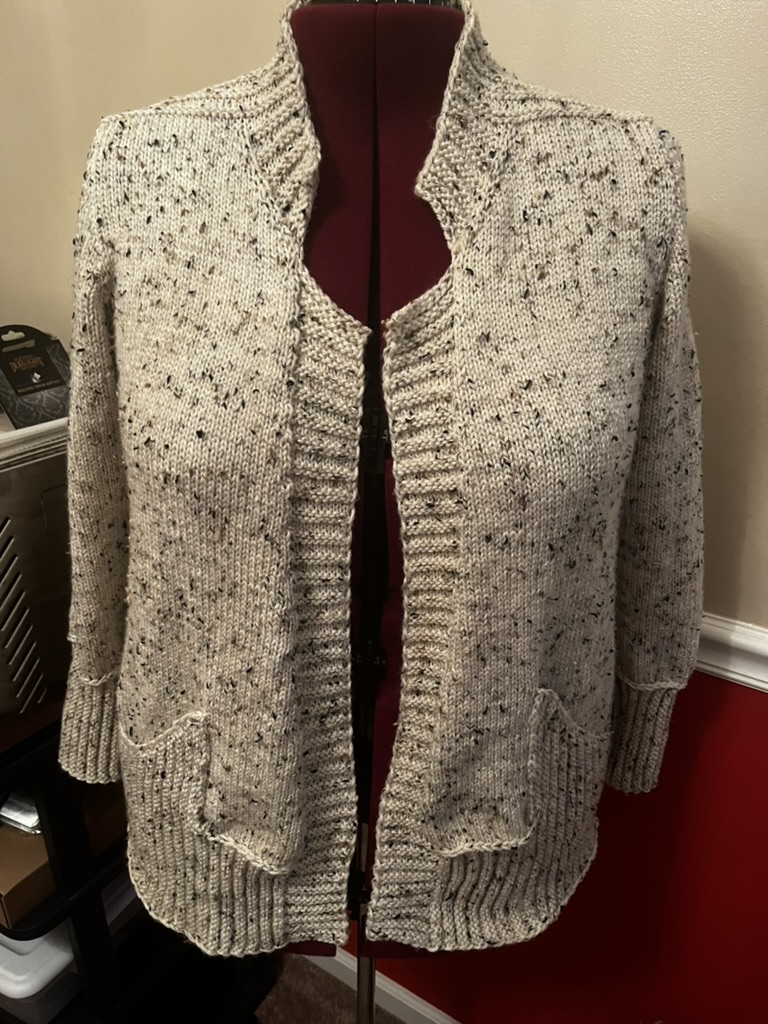
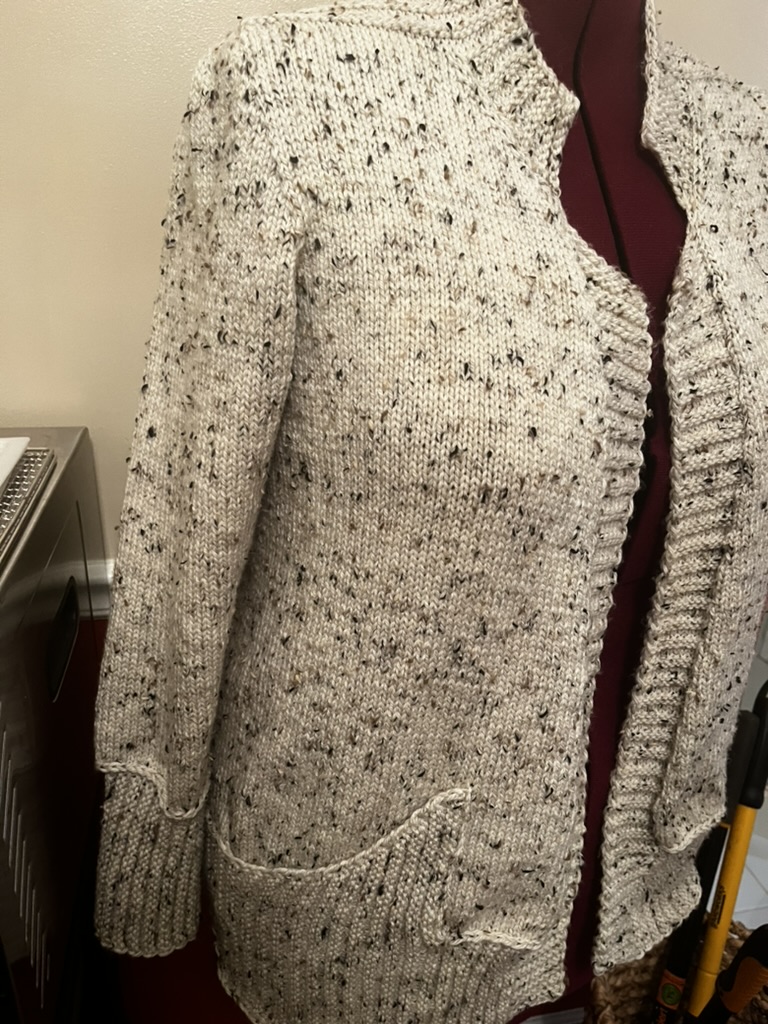
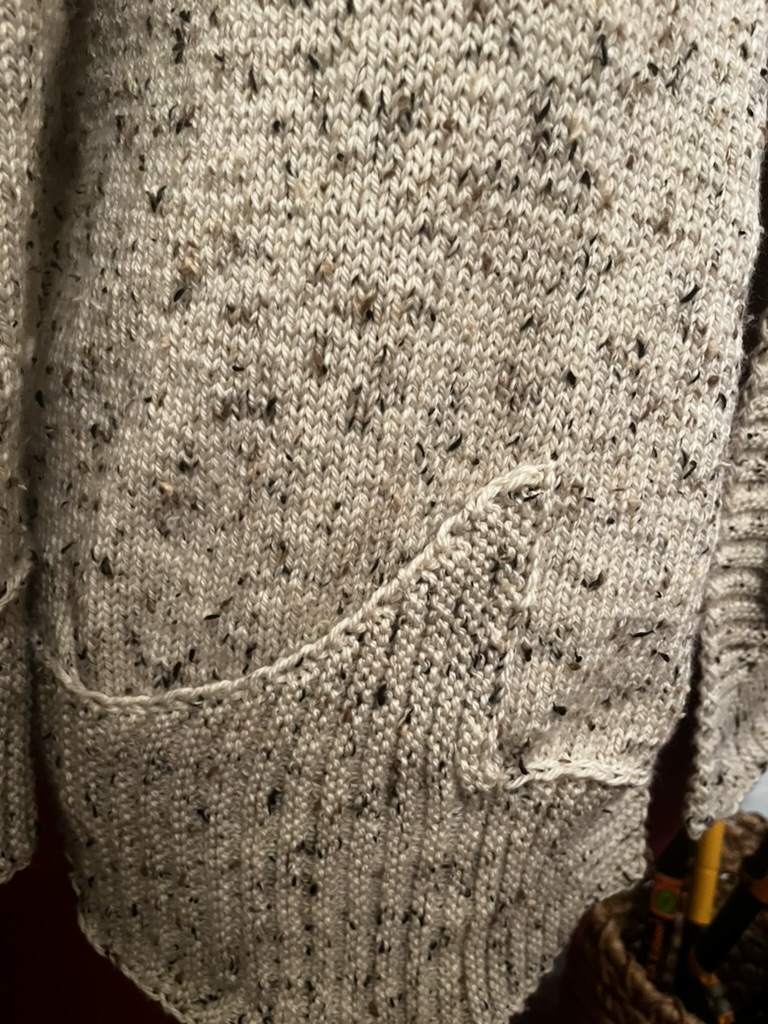
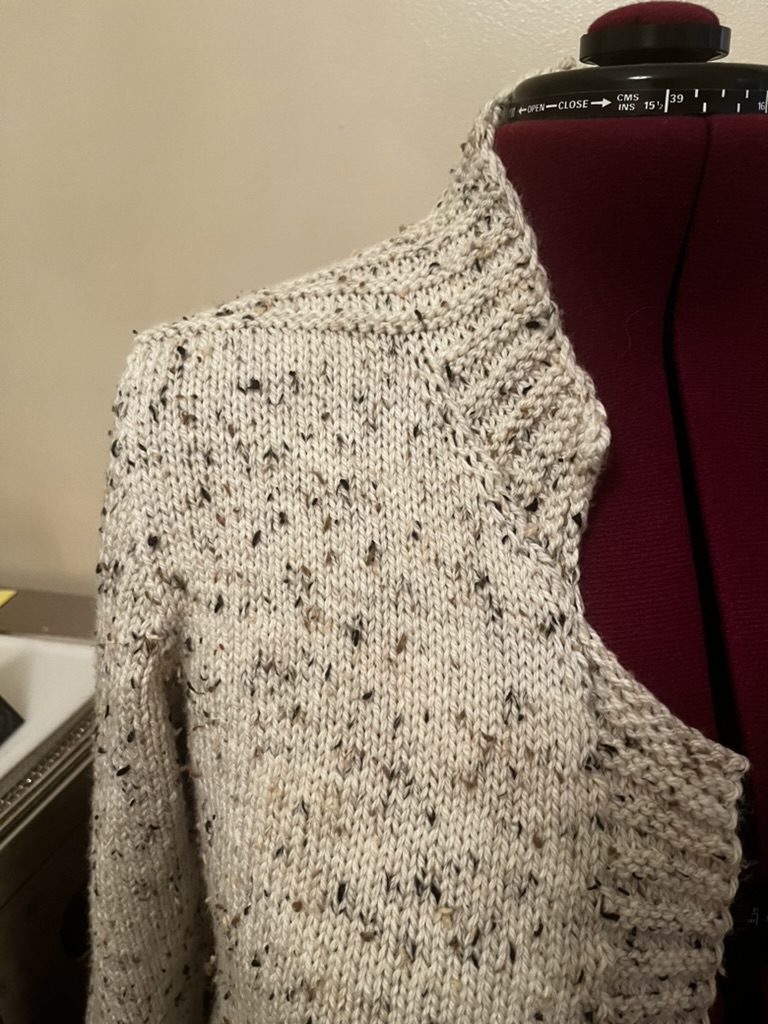
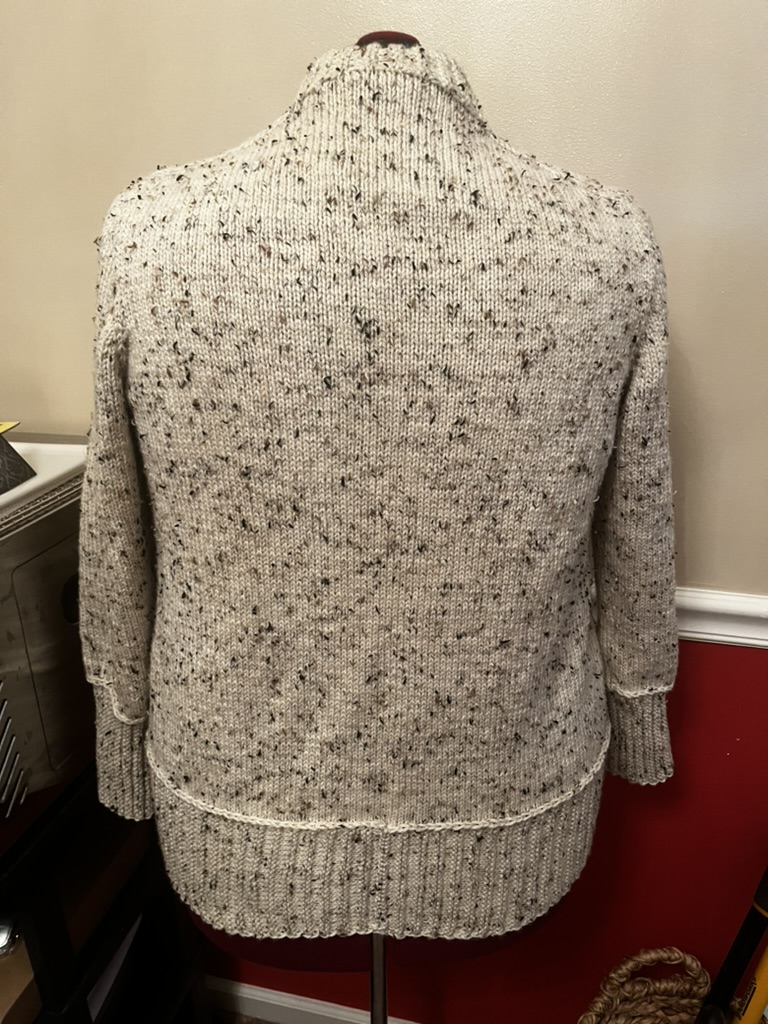
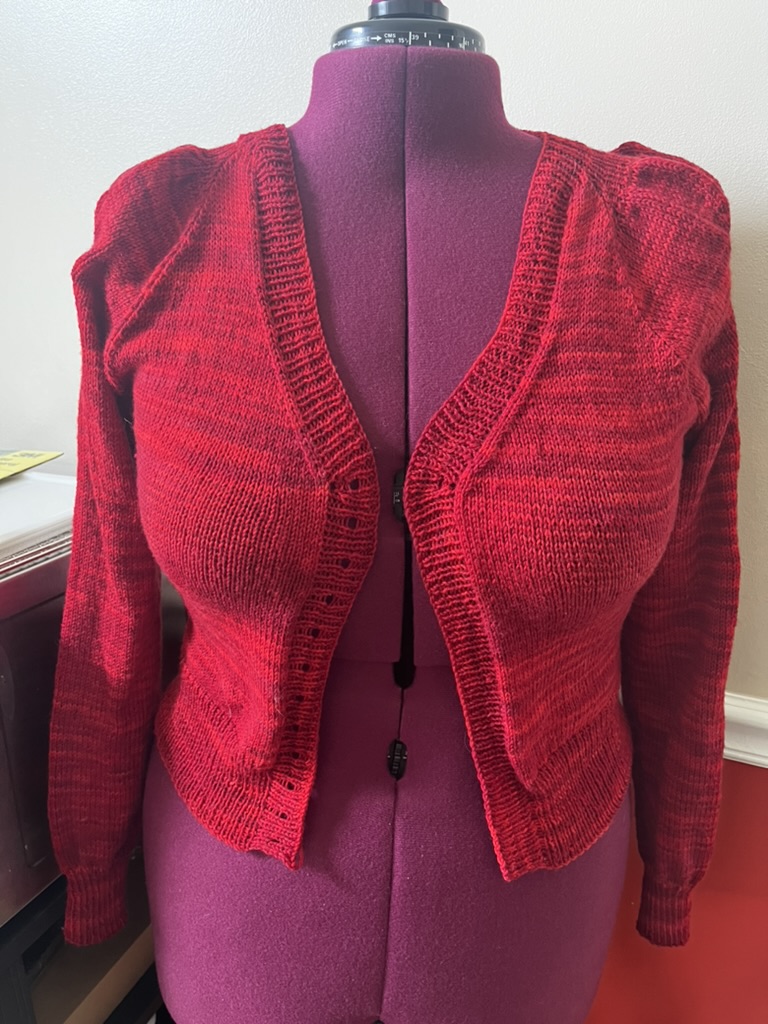
This, though, is the Big Sister cardigan by Hinterm Stein, and for the first time in ages, I didn’t find a single thing in the pattern I wanted to change. The start, a rectangle on the back, increasing into the shoulders and then fronts, is cleverly done and intuitive. The notch at the collar is just right, and keeps the faux-ribbing at the edges from pulling in too much and looking like the button band area is a size too small. Knitting on the bottom edging with the 1-2 decrease pattern works perfectly. Also, done in aran yarn (which is undyed donegal aran from wool2dyefor), it’s going to be a super snuggly sweater for the wintertime, which given the local climate, will be able to double as my winter coat. Given the deep pockets, I think it’ll be the perfect winter coat.
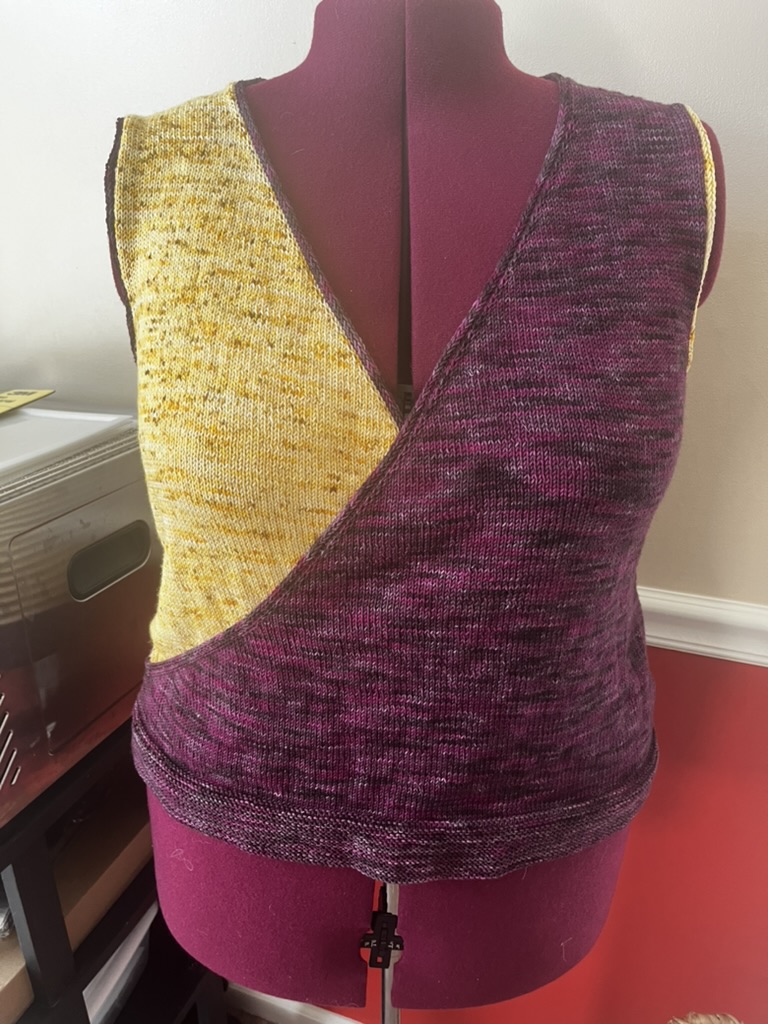
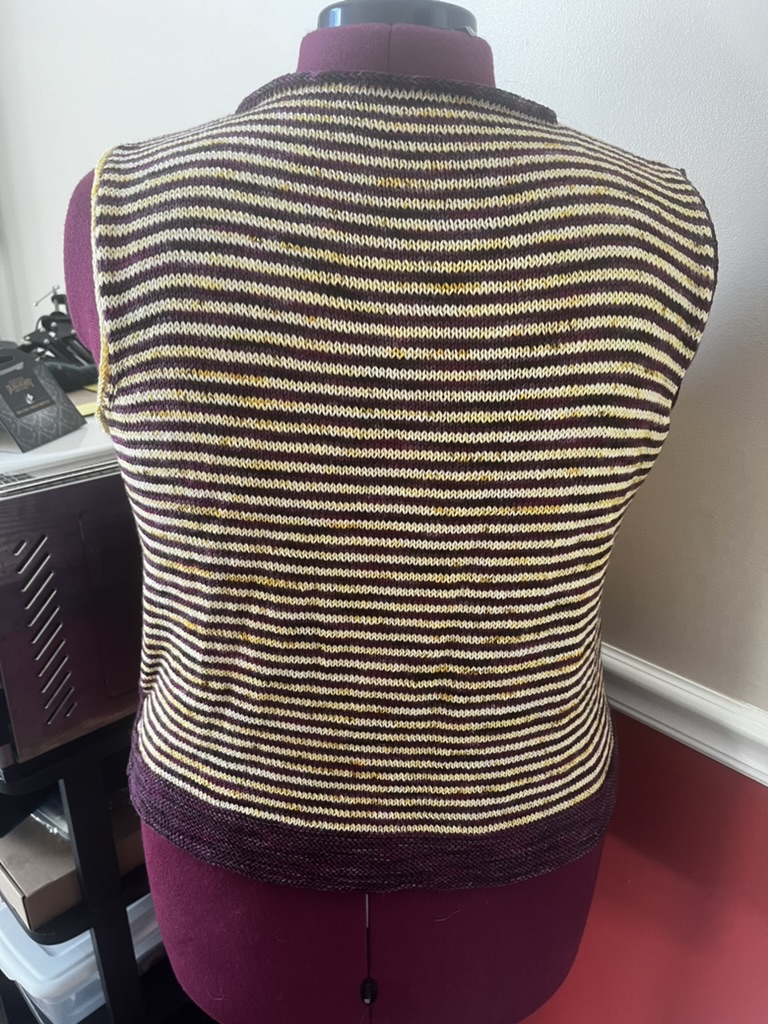
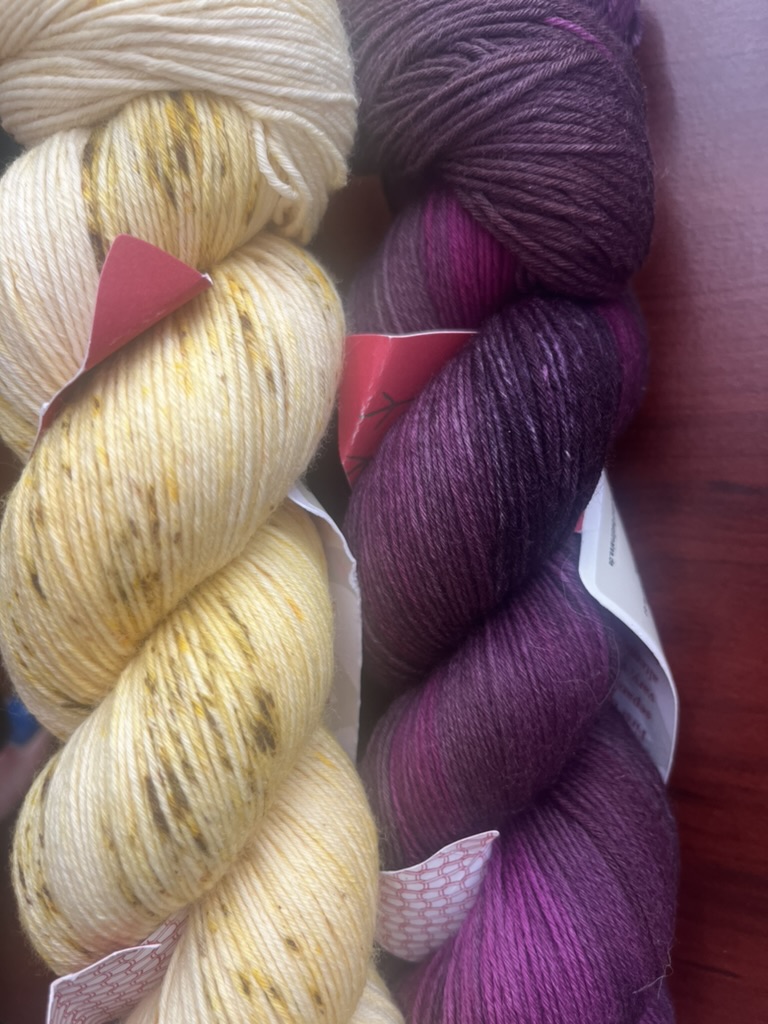
Hey! It’s not blocked yet, but my crisscross shirt is done. The edges are rolling a little in the photos, but I’m sure a wash and block will cure that. As is my usual issue with speckled yarn, I think it looks better in person than photos, so I’m sorry they look pretty meh. (the yarn in the skein looks beautiful, obviously, and in person, the sweater looks pretty great in my opinion.)
The pattern is nice and simple, well-written and easy to follow, with a great schematic, and I’ll definitely be keeping an eye on the designer in the future. Love these useful, wearable designs, and think I’ll get a lot of use out of the sweater.
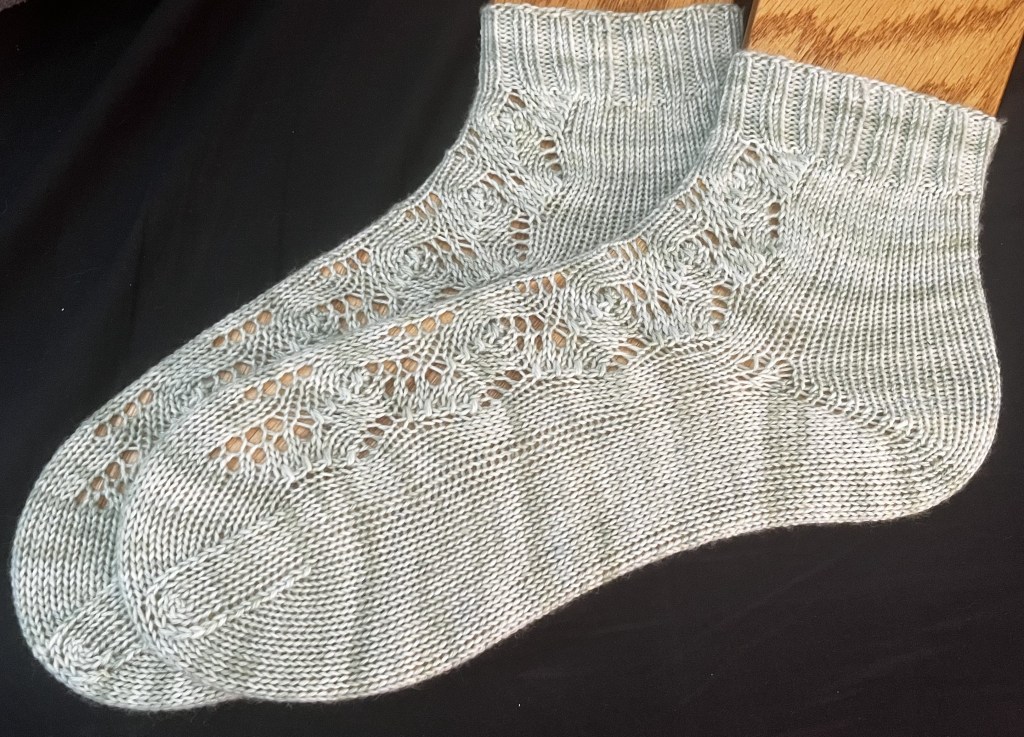
Back to those #PridePodMAL socks, they’re done! This is what happens when you make socks for a person with tiny feet, I think, and it’s kind of amazing. They took maybe 12 hours of knitting all together, and they’re done. Again, it’s the Wildwood Socks pattern by Catherine Meyer aka GingerDogKnits. The lace pattern is quite simple, both written and charted, and I love how it turns out.
The color is terribly washed out in the photo, it’s called pistachio, and IRL it’s a beautiful tonal cool green I got from the Etsy shop WhimzeeStitches. I’m really glad I probably have enough left of it to make myself a pair of short socks too.
Since the socks are very small, I didn’t block them on my giant foot sock blockers and stretch them all out of shape; I’m waiting till a pair of smaller blockers I ordered comes in, since I won’t be seeing the recipient for the next few weeks anyway. I know sock blockers aren’t a requirement, but I like the uniform way they make the socks look, so I use them.
This is the first time I’ve finished a pair of socks in . . . a while. But they went well and were fun, so I think I’ll be going back to more of them. Goodness knows I have enough sock yarn waiting to be used.
About four years ago I made a Ripple Bralette by Jessie Maed Designs, who might just be my favorite designer. Okay, one of them. One can never discount Joji Locatelli, and I like them for similar reasons: they design relatively simple sweaters with clever construction, that are thoroughly wearable garments. None of that stuff your great grandmother made with extra bobbles and chevrons and 576 colors.
The initial bralette was a single skein of green yarn, and it made a nice layering piece for the dead of frozen winter in Iowa, but it also got me thinking: wouldn’t this make a great tank top, if I just made it long?
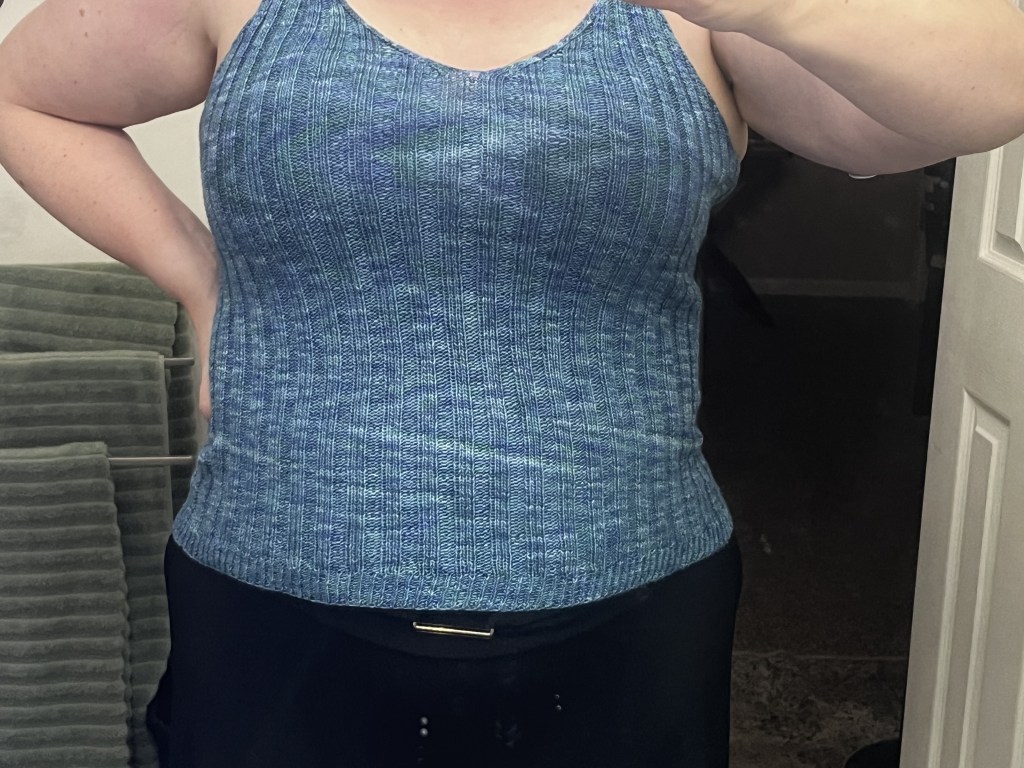
So I grabbed two hanks of Ella Rae lace merino (which is, ironically, actually a light fingering weight yarn) both in the same lovely blue-green colorway—the brand unfortunately doesn’t give them fun names, but numbers, and I don’t remember this boring number. I wound them both and stuck them in a project bag in my car. At the time, because of an issue with the car, I was spending a lot of time sitting in the car doing nothing, so I figured I could instead spend that time working 3×3 ribbing on tiny needles forever.
The problem was that when we moved to North Carolina, I wasn’t doing that anymore, so what had been a project moving slowly but steadily forward became entirely stagnant. When I took it out of my car and brought it in to work on last week, I thought I’d continue to take forever to finish it, but it turns out I didn’t have that much left. I finished it, one of the few patterns I knit precisely to pattern, no major changes to what the designer wrote, other than knitting the body for about 14″ instead of 4″.
Since I started it years ago, that also meant it was made two or three sizes larger than necessary, but in the end, I think that doesn’t show at all, since it’s knit in ribbing, and is still 100% fitted.
I’ll definitely, always, be making more of Jessie’s patterns. Fabulous construction and easy to wear, love it.
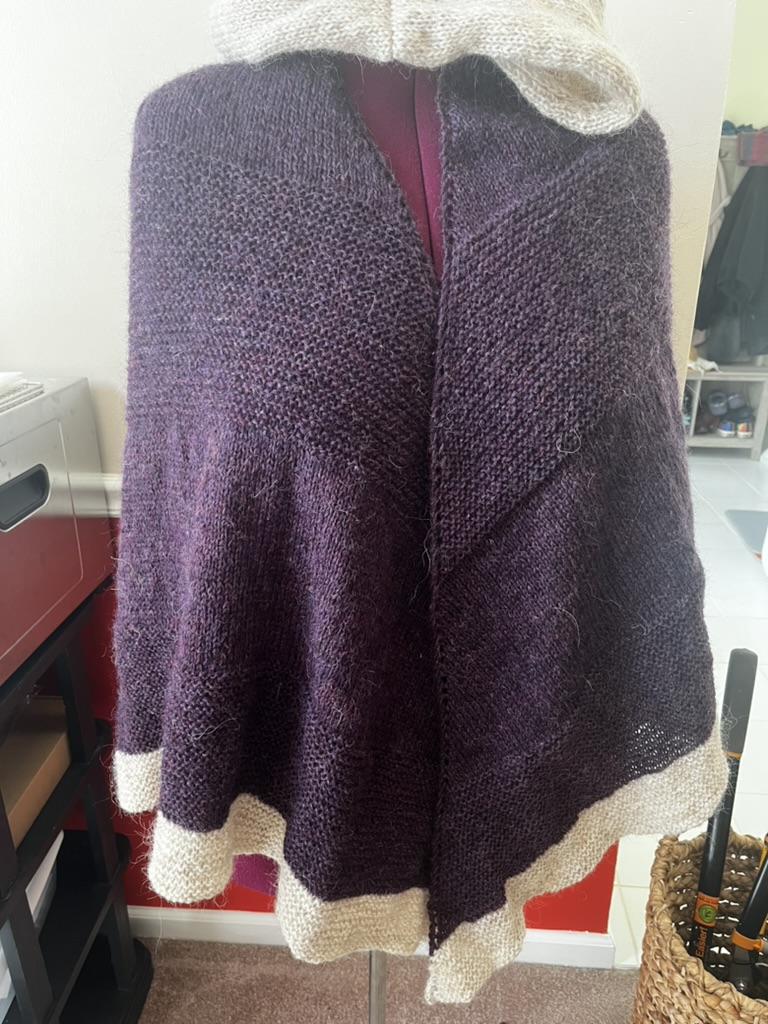
Yeah, so anyone who got here from my writing knows darn well I fantasize about being the actual fox whisperer. I guess making the hooded shawl pattern by the same name will have to do, though.
Here’s The Fox Whisperer, by Judy Jewell. She’s a new to me designer, and I found her because . . . why yes, I did just type “fox” into Ravelry‘s pattern search just to see what came up. Honestly, their database just tickles the techie in me. SO MANY search parameters. Sure, you can search for random fox patterns, but you can also search by yarn, yarn weight, yardage/meterage, pattern type, desired gauge, and dozens of other things. I only got about a year into a programming degree as a wee 20-something, but Cassidy of Ravelry is 20-something me’s programming hero. Whenever someone asks what a database is good for, Ravelry is the answer.
Anyway, The Fox Whisperer. The sample is knit in a lopi unspun yarn, and it’s the recommended yarn as well. All my years knitting, this is actually the first time I’ve worked with a lopi yarn. I got mine at The Icelandic Store, frankly because I’m a little cheap, and even with insanely expensive international shipping, it’s cheaper than you can get it from anywhere here in the US.
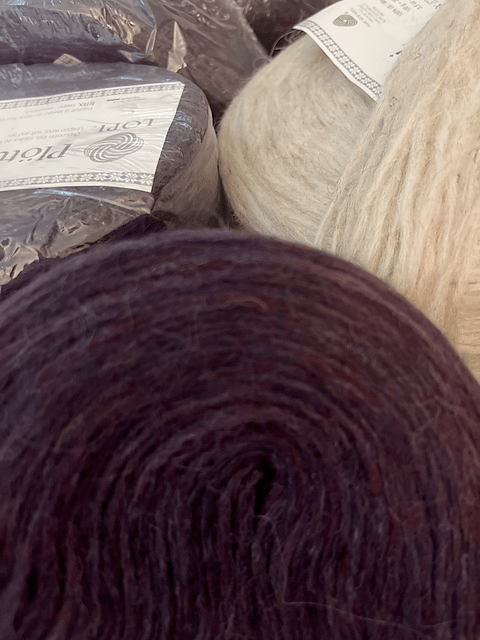
My yarn, in my chosen colors. The purple really doesn’t photograph well, but it’s a beautiful plum shade.
Now, the designer used a lighter yarn held double, but since I went with ístex’s Plötulopi, I only held a single strand the whole time.
About the yarn: It comes in what the designer calls plates, and I think that’s a fair description. They’re flat-ish and round, basically discs of yarn. They’re also just what the name says: unspun. This isn’t a singles yarn, or twisted tight like those lovely bouncy plied yarns most of us are used to. It’s just wool fibers held loosely together by the friction created by wool’s scaly nature. If you tug on the end of this yarn, it’ll come apart in your hands. This effect is so strong that there’s a note on the maker’s website that suggests knitting continental style to avoid extra tugging that can make the yarn come apart.
So I’ll just come out and say it. This is not my favorite yarn to work with. I knit semi-English (most people I’ve seen talk about it call the style I use “flicking”), and while I don’t tension tight enough that I had a problem with it coming apart much while I was working, a few times when I set the project down and came back to it, just the act of picking up the shawl made the yarn break. There’s a note in the pattern that says when wet, the shawl is incredibly delicate, and will fall apart, so to be very careful with it. This is not hard to imagine being true. While it’s pretty hardy all knit up together, wet wool is more delicate than dry, and this unspun stuff is like air.
I’m not saying I dislike it, or not to knit with it—it definitely has its place, and I think it’ll make incredible colorwork. In fact, I’ve got my eye on, and the yarn for, Into the Wild by Tania Barley. Mostly, I’m just saying it’s never going to be my very favorite yarn. For anyone sensitive to this issue, it’s also definitely a rustic wool, and people who don’t like the idea of wool probably couldn’t wear it next to their skin. FWIW, I used to be one of those people, and once I fell in love with wool, my tolerance for “itchiness” increased quite a lot. If that’s you, maybe start with a nice cushy superwash merino and work your way up from there.
The pattern was great, and written in a lovely conversational style, so I’ll definitely be considering future patterns by the designer. I left off the picot edging because I don’t much like picots, and didn’t decrease the hood because I prefer a deep hood, but those were simple changes, nothing that changed the essential pattern, which was quite simple.
Sorry for the lack of a good hood picture, but I can’t take that myself, and Mr. Lucky isn’t much of a photographer.
It’ll be hard to believe for anyone looking at the projects side by side, but this project used about the same amount of yardage as the Minerva Cardigan. How? This was knit on a size 9 US needle, and Minerva was a size 5, with much thinner yarn. I haven’t worked up the courage to block it yet because of the dire threats that it’ll fall apart, but I’ll get there. Probably.
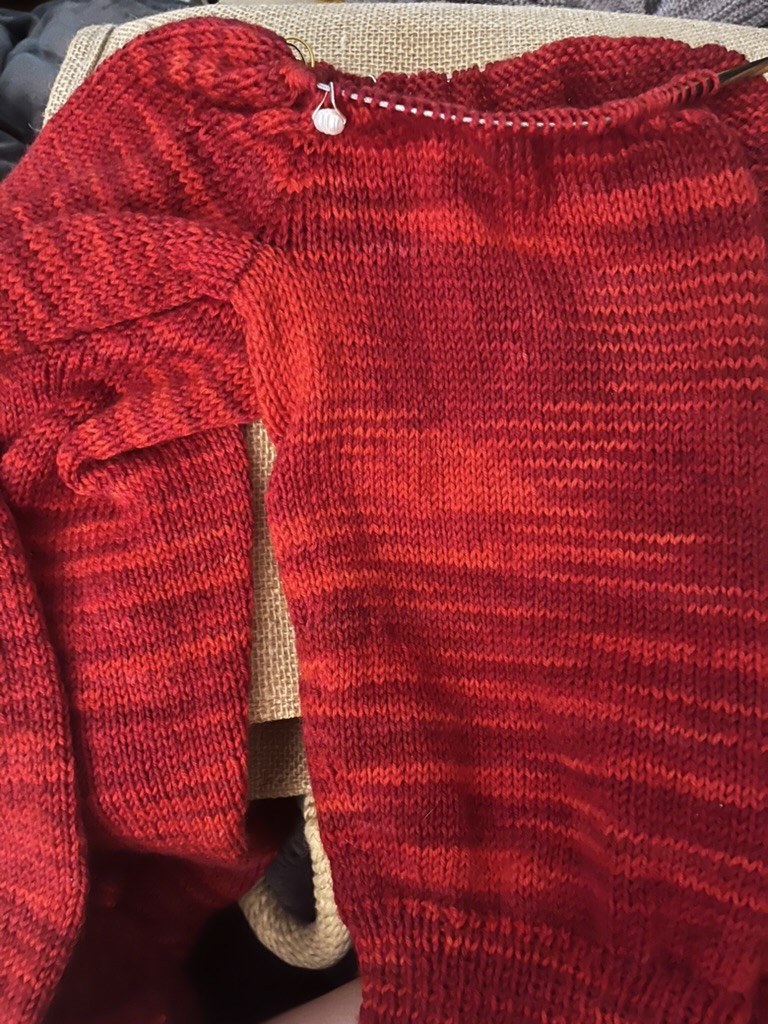
And so far, the cardigan had taken me four days: two for the main body, and two for these little sleeve nubbins. The remainder of the sleeves took me another day and a half of steady knitting, and then I connected them to the body.
If you haven’t knit a bottom-up sweater, be forewarned, the five or ten rows after you connect sleeves to a body are a pain in the butt. You have to keep the sleeves very bunched up and all on the needles at once, because you’re essentially asking what was flat to become round. Technically, the sleeves being knit in the round, this isn’t actually what you’re doing, but the spots where body meets sleeve are very stubborn and don’t like their new place in life, so they take it out on you for a while.
Here we are, some measure into the rest. With three balls wound, I used one to do the body, and one for each sleeve. Then when I connected the body, I went back to the one I’d been using there. It ran out right about the time of this picture, so I attached one of the sleeve balls and continued on. That second ball was enough to finish the sweater, so I used a total of 2.5 balls, meaning the whole sweater cost under $50, including enough extra yarn to make a pair of short socks or a hat or something.
I’ll note here that the sweater was written by someone whose first language isn’t English, so there was one point in the pattern I was concerned people might be confused by: Once she says to start the raglan increases, you continue them for the rest of the sweater until you get to the neck. When she goes to the explanation of how to increase for the sleeve puffs, you continue the raglan decreases as you have been every other row, even though the pattern is a little vague about that part.
The sleeve puffs? Are fabulous. Honestly, they make me want to knit another one, because I just love the construction of them, I’ll definitely be knitting more patterns by the designer, because this one is lovely and elegant in its finished version.
Oh, you actually wanted to see the whole sweater?
I guess. Well, fair warning, I haven’t sewn the buttons on yet, because like every knitter, finishing eludes me sometimes. I did the knitting, why is there more work? But yeah, here’s Minerva:
It’s a little tight, but that’s probably back to my slightly-small gauge rather than the pattern. It’s also not too tight, I’m mostly worried about the buttons pulling a little when I finish and put it on. Maybe in another five pounds or so.
All together, Minerva took me about six or seven days of knitting, and a lot of them were just the sleeves. Those sleeves’ll get you every time. But don’t get trapped on sleeve island. The sweater’s worth finishing. It totaled about 1200 yards of yarn for my size 2x behind, so it’s a tiny amount of yarn, for a full sleeve sweater.
Once again bathroom mirror pic, but it’s not the worst picture. Partially because of the happenings of the previous post and my rift sweater, I decided to knit it in a size that wasn’t overly large on me. In this case, since the sweater is supposed to be quite large, that meant knitting it about 4 sizes too small. I knit the body in the smallest size available, the neck in my own size, and then, because bringing the body in that drastically meant the sweater hit my upper arms, not my elbow or so, I made the arms deeper, just by knitting the top of the sweater to 8-9″ before joining under the arms.
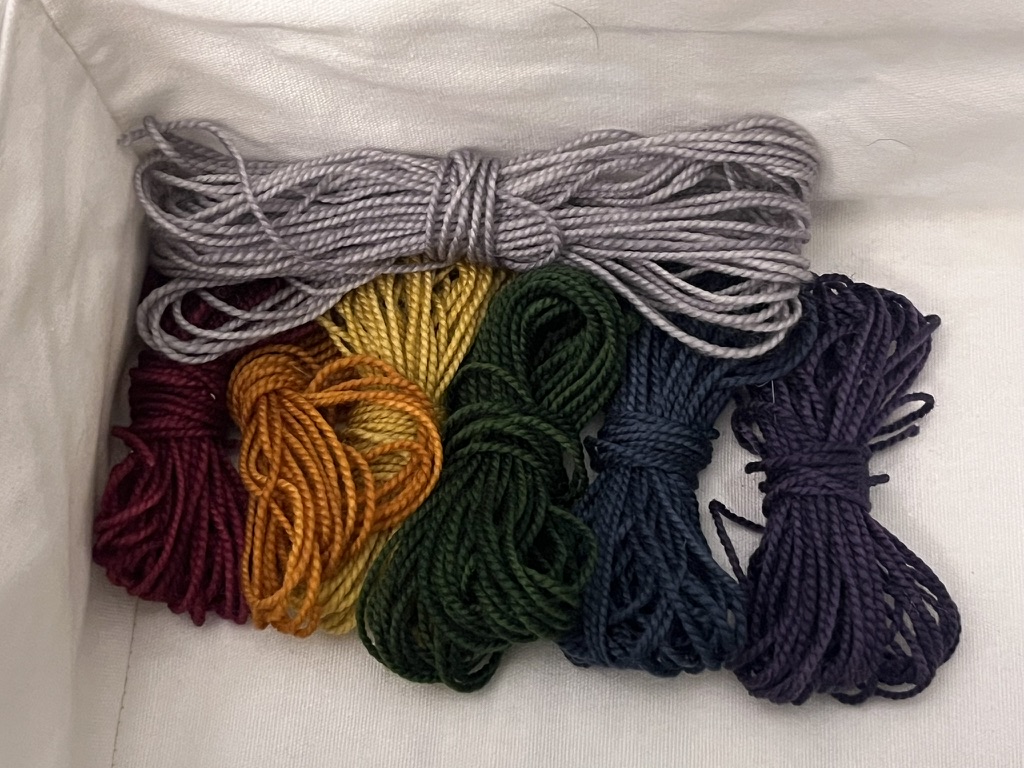
The yarn I have left:
Between the size change and the 3″ sleeves, since I don’t especially like sleeves that come past my elbow, I used all but a few yards of every color, for something like 1500 yards of Miss Babs fingering weight yarn. I’d been planning on making the Muppet shawl by Lyrical Knits with this, and even bought it as a kit, but when I started to see the spoiler pictures of it, I realized it was in a shape I don’t really wear much. Plus I just forced my poor co-writer and PA to take a whole bunch of knitted shawls earlier this month. Knitting a bunch more isn’t the answer, even if I do love a good lace knit.
Now I guess I should go work on finishing that Tiong Bahru that’s been on my needles for . . . (checks notes) almost eleven years. Oops.
Okay, I’m trying not to flash anyone, but at the moment, it’s a bit of a struggle.
I was listening to a years-old episode of the Yarniacs, and one of them said that she thought women tended to knit maybe a little bigger than their size, which feels true to me as well. I’ve always knit garments a little big, because I like a loose fit, and also, I know myself. I know my love for bread. I never expect to lose weight.
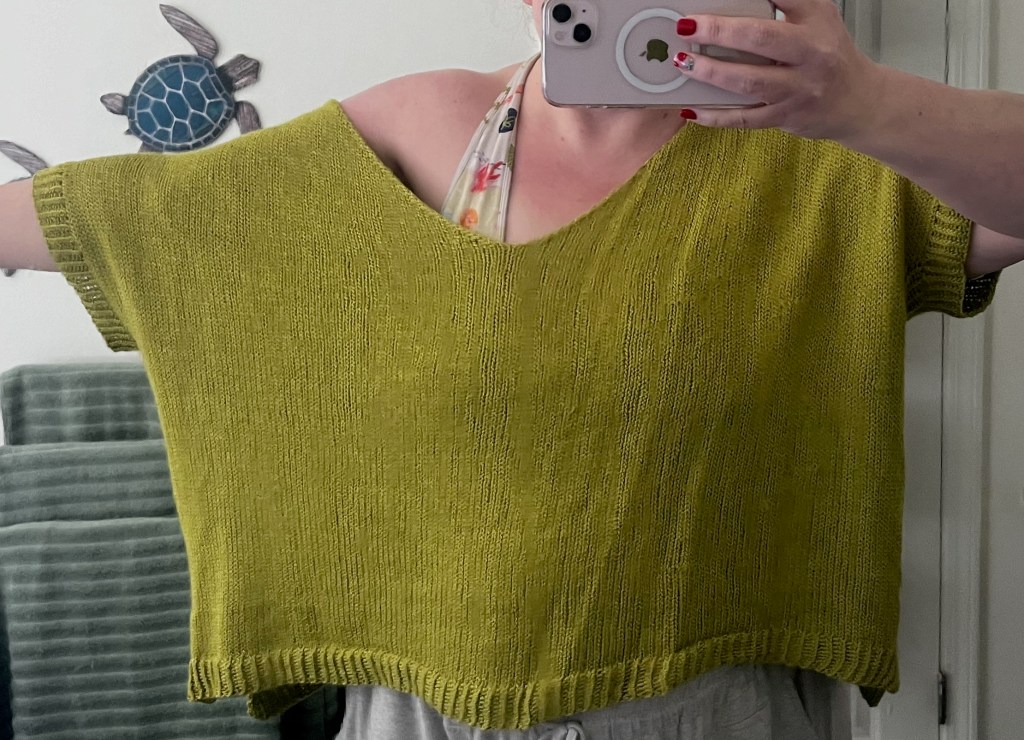
The problem with that is that in the last year and a half, I’ve lost about fifty pounds, for various reasons. I’m not especially trying to, but it’s fine, and I won’t complain . . . except that I just put on a rift sweater that I knit two years ago. I knit it about a size too big at the time, and well, now I look like I’m auditioning for an 80s music video, because the neckline is so wide it won’t stay up on my shoulders.
Sorry for the dirty bathroom mirror picture, but here’s the effect:
It’s kind of okay, since I’m just wearing it with my pajamas to keep warm on a cool morning, but it’s no longer a sweater I can wear out. I know losing fifty pounds isn’t exactly a normal thing, and it’s not going to happen to anyone under normal circumstances—though there’s a decent chance I’m going to keep going a while, hopefully not too long—but it’s something I think I need to start keeping in mind. If I’d knit my proper size before, it would still be too big now, but maybe not quite as comically large.
So from now on, knit your own size, Isolinde!
What about you? Knit too big? Your own size? Thoughts on why we tend to knit the wrong size?
I mentioned recently that I’d just taught myself mattress stitch, which . . . is poor planning on my part. Which is definitely a thing I’m prone to doing. I tend to think things through enough to decide a course of action, then I’m set on that course, and nothing will make me deviate. Sometimes not even proof it’s wrong. (See: strengths, Strategic, which is not always all that strategic in practice.)
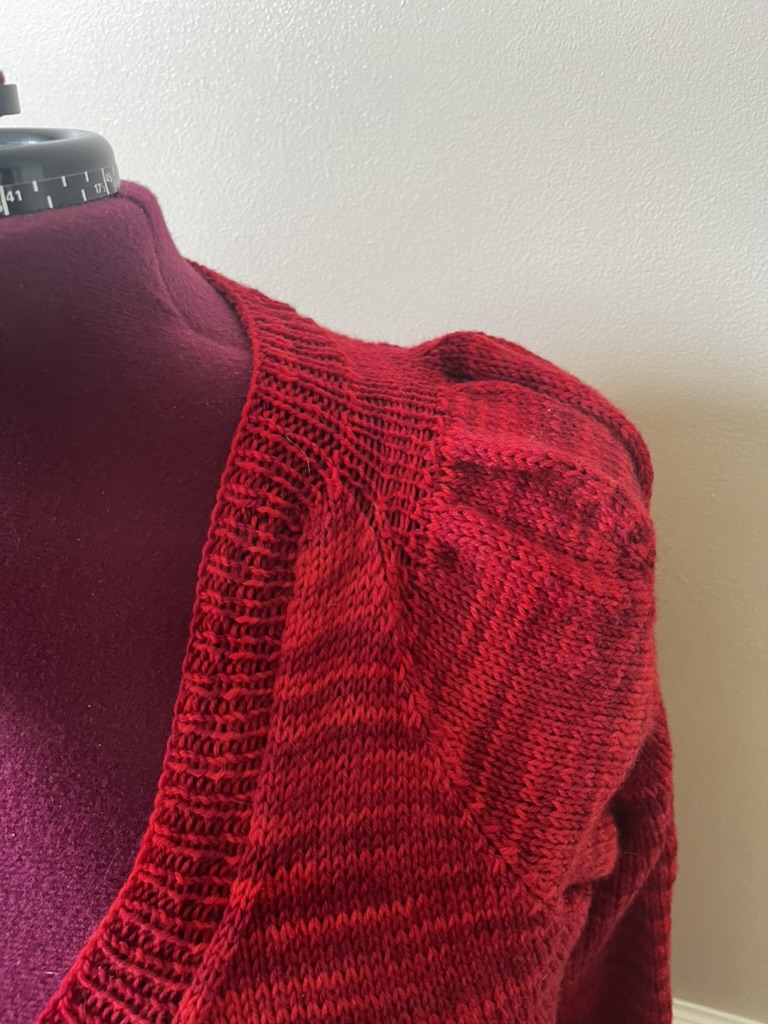
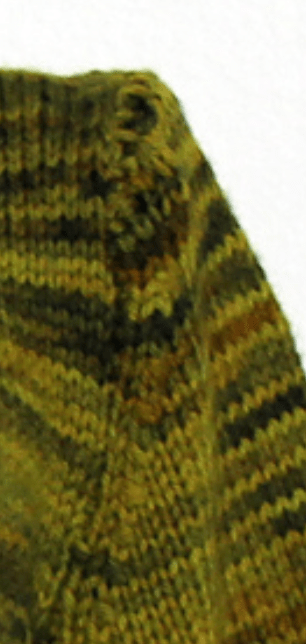
Other people talked about seaming sweaters over the years like it was a minor annoyance, while I deliberately sought out sweater patterns with no seams, because whenever I had to seam a sweater, it just came out looking wrong. I’d just whip-stitch the right spots, and it came out messy and . . . calling it imperfect would be an insult to imperfection. It was a disaster. I don’t have any great pictures, and I’ve gotten rid of the last offending sweater, which is too bad, because properly seamed, it would have been lovely.
On the right is the best picture I have of the shoulder seam, which is hard to see, but I think it proves my point nicely: Isolinde was no longer allowed to seam sweaters after this. Miles of raglan shaping was my sweater-knitting life. That was okay, because I like raglan shaping, but it was also really limiting for what I was and wasn’t able to knit, so last week I decided to fix this problem, and took to my knitting library.
It turns out that yes, I was missing something incredibly simple that would have fixed everything right up. In fact, it turns out that seaming sweaters is way simpler than I thought. Coming from a background of sewing, I automatically turned right sides to face each other when seaming, and with sweaters? You don’t have to do that. You can work on the right side of the fabric, and when you’re finished, the seam turns to the inside automatically.
This video is from Very Pink Knits, and Staci shows you in three minutes how to fix a problem I had for years:
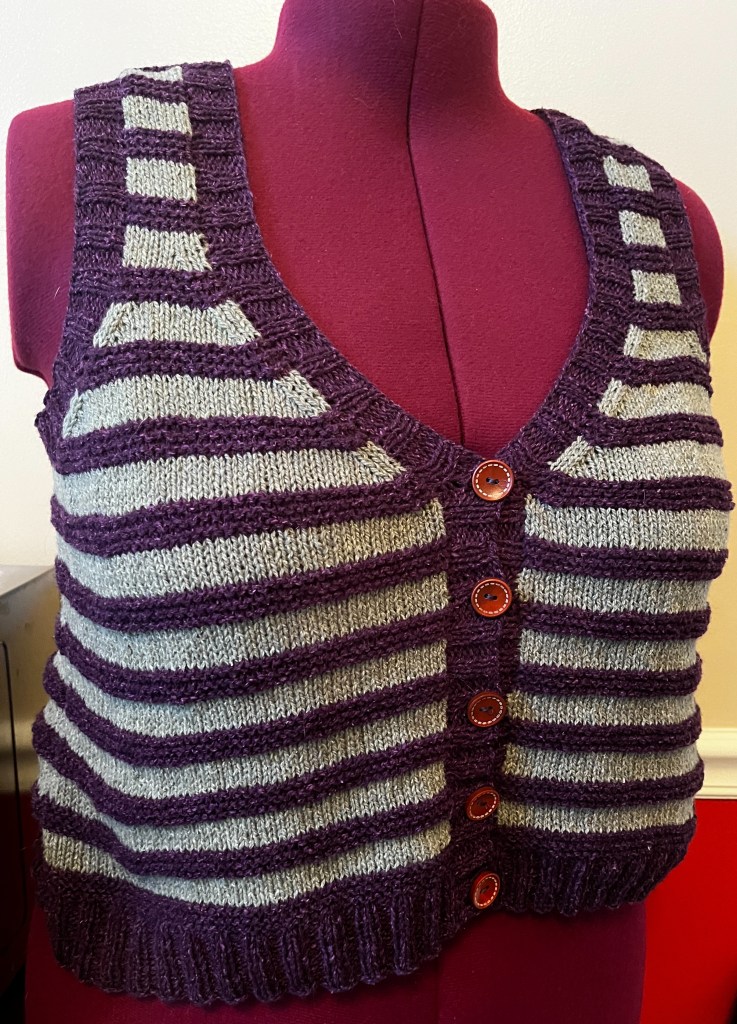
After figuring out the best way to do this, I jumped in and seamed a vest I’d made, and I think it turned out pretty darn well. You can’t see the seam, but it IS in the picture, which I think is rather the point. Buttons and their placement is still a problem area, but hey, one step at a time!
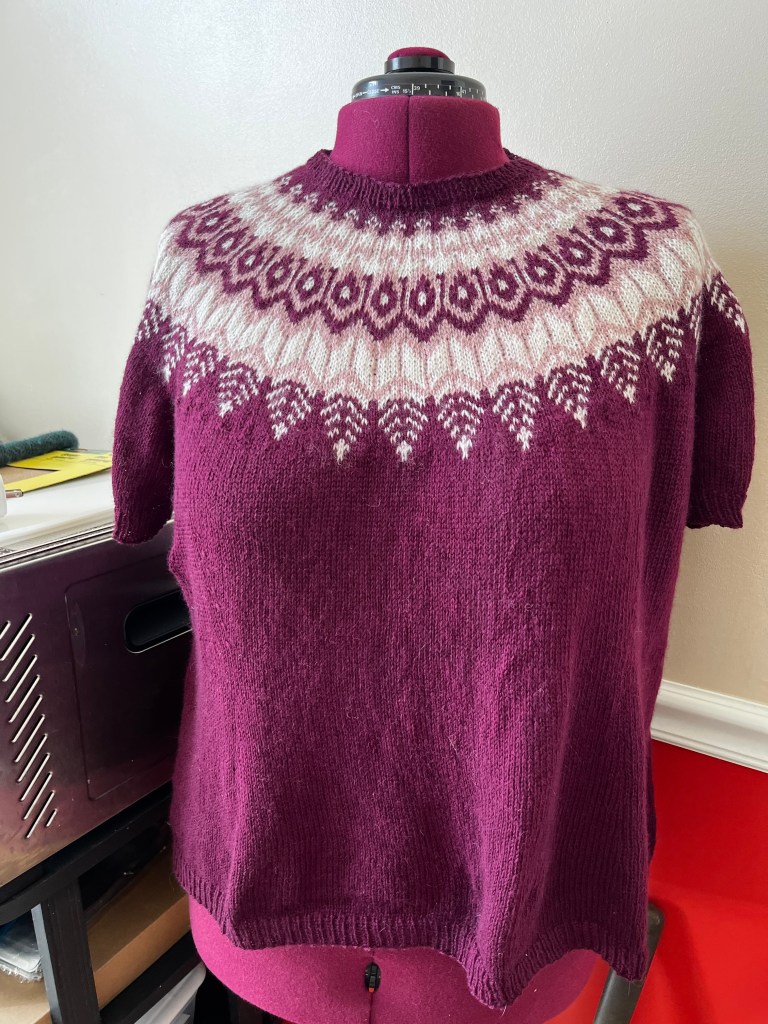
Hey all! This is Lindey, and that is Threipmuir by Ysolda Teague, and my very first attempt at a stranded colorwork yoke sweater. I’ve dabbled in hats before, but this is a new one for me. I enjoyed it, and with the short sleeves, it knit up super fast (about a week), and I think it came out pretty darn well. The jaquard ladderback at the feather tips is an interesting technique to avoid long floats that I’ll have to keep in mind for the future.
All this mostly to say hi! This blog is a new thing for me, and I’m going back to knitting in an attempt to stop working myself to death and do something fun instead of working 80 hour weeks because well, I get inspired. I’ve got plans for projects, some small and some probably unrealistically large, and in the coming weeks, I’ll get started talking about them!

 Knitting Over the Rainbow